










Breaking News
 What COVID Policy Did To Doctors Who Refused To Stay Silent
 "Entirely Demonic": Catherine Austin Fitts Warns Financial Tsunami Coming Because Of...
 Trump Says US "Hammering Iran's Ability To Threaten Shipping", Warns Xi Summit Could S
 It Is Being Projected That "Peak War Panic" Could Hit The Global Financial System In 1 To
Top Tech News
 Musk Whips Out 'Macrohard' In Disruptive Tesla-xAI Bid To Shaft Software Companies
 This Bonkers Folding X-Plane Is One Step Closer to Hitting the Skies
 Smart 2-in-1 digital microscope goes desktop or handheld as needed
 Human Brain Cells Merge With Silica To Play DOOM
 Will Yann LeCun Provide The Next Breakthrough In AI?
 Human Brain Cells Merge With Silica To Play DOOM
 Solar And Storage Could Reshape Rural Electricity Markets
 With World Seemingly At War, DARPA Finds Time To Unveil The X-76
 Renewable Water From Air.
 The world's first diesel plug-in hybrid pickup truck is here



Now They Are Actually Admitting That There Is A Massive "Gravity Hole" Underneath Antarcti
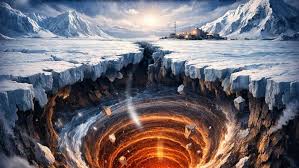
Experts assured us that nothing unusual was going on and that there wasn't anything to be concerned about. Of course we couldn't go investigate for ourselves, because as you will see below, there are 72 areas of Antarctica that only those with a special permit are allowed to enter. And if you try to fly to Antarctica without authorization, you will get into all sorts of trouble.
So why all the secrecy?
What are they trying to hide from all the rest of us?
One thing that scientists are admitting about Antarctica is that it sits directly above the strongest "gravity hole" on the entire planet…
Earth may look like a smooth "blue marble" from space, but it's better to imagine it as a slightly gnarled orange, with an inside that's firm in parts, but squishier in others. Since the planet isn't a perfect sphere and its internal density varies across the globe, gravitational pull changes from place to place. Where there's less mass in the underlying geology, gravity is weaker, and vice versa.
These dips in the gravitational field are formally known as gravity anomalies, but they're more commonly called "gravity holes". The largest is found in the middle of the Indian Ocean, spanning over 3 million square kilometers (roughly 1,100,000 square miles), while the strongest is found in Antarctica.
Isn't that interesting?
It turns out that there is a gigantic "hole" under Antarctica after all.
But the experts are insisting that there really isn't anything particularly special about it. In fact, they try to make it sound as boring as possible…
A "gravity hole" beneath Antarctica sounds like the plot to a bad sci-fi movie, but it's a very real situation deep beneath the Earth's surface stretching back tens of millions of years. The phenomenon thankfully isn't as apocalyptic as it sounds, either. In fact, researchers say these complex interactions between rock densities, gravitational pull, and sea levels are actually helping them understand how the southernmost continent's ice sheets evolved, and what their influences mean for the planet's climate.
Yawn.
That does sound pretty boring.
But could it be possible that there is a lot more to this than we are being told?
It is being reported that the team of researchers that mapped the colossal gravity hole directly under Antarctica was able to use a combination of methods to actually "reconstruct the three-dimensional structure" that exists underneath the continent…
In the study, published recently in Scientific Reports, Forte and Petar Glišovi?, Ph.D., of the Paris Institute of Earth Physics, mapped the Antarctic gravity hole and revealed how it developed over millions of years. They relied on an Earth-spanning scientific project that combined global earthquake recordings with physics-based modeling to reconstruct the three-dimensional structure inside Earth.