










Breaking News
 Just Get Out! Now!
 THE WEAPONIZATION OF GOVERNMENT AGAINST IT'S PEOPLE
 Trump Begs For Help On Hormuz; World Says 'No.:
 American begins drafting Gen Z to fight in war against Iran
Top Tech News
 Musk Whips Out 'Macrohard' In Disruptive Tesla-xAI Bid To Shaft Software Companies
 This Bonkers Folding X-Plane Is One Step Closer to Hitting the Skies
 Smart 2-in-1 digital microscope goes desktop or handheld as needed
 Human Brain Cells Merge With Silica To Play DOOM
 Will Yann LeCun Provide The Next Breakthrough In AI?
 Human Brain Cells Merge With Silica To Play DOOM
 Solar And Storage Could Reshape Rural Electricity Markets
 With World Seemingly At War, DARPA Finds Time To Unveil The X-76
 Renewable Water From Air.
 The world's first diesel plug-in hybrid pickup truck is here



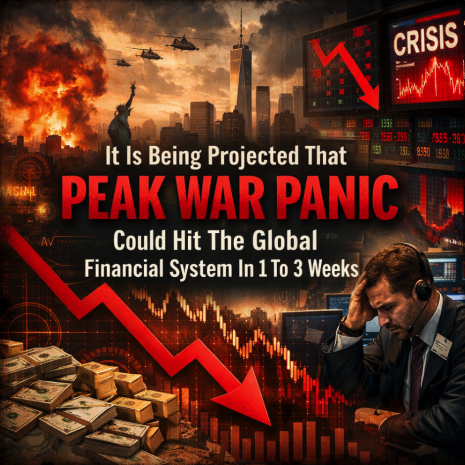
It Is Being Projected That "Peak War Panic" Could Hit The Global Financial System In 1 To
Traffic through the Strait of Hormuz has been essentially paralyzed by the war with Iran, and there is a lot of speculation that the Houthis could soon bring commercial traffic through the Red Sea to a screeching halt. If such a scenario actually materializes, it would be catastrophic for the global economy. The good news is that so far we are not witnessing widespread panic among investors. Most of them still seem to believe that this crisis is just temporary. So even though the price of oil is up over 40 percent since the start of the war, the overall global financial system is still relatively stable at this stage…
The S&P 500 is only down 3% so far this year and 5% off its all-time high, still far from reaching bear market territory or even a correction, suggesting investors aren't panicking yet about the U.S.-Israel war on Iran. But that could change soon.
To be sure, oil prices have soared more than 40% since the war began two weeks ago and are up nearly 70% year to date. But they remain below the peak seen after Russia invaded Ukraine in 2022, despite one-fifth of the world's oil supplies being bottled up by Iran's de facto blockade of the Strait of Hormuz.
Of course it certainly wouldn't take much to push the financial markets over the edge.
Dan Alamariu, the chief geopolitical strategist at Alpine Macro, is warning that if this war with Iran persists we could see "peak war panic" in approximately 1 to 3 weeks…
Alamariu acknowledged there's a growing chance that the war lasts longer than his two-month outlook, and the Strait of Hormuz would likely remain closed for the duration. That means Brent crude prices will stay above $100 a barrel and possibly even top $150. And yet, the market hasn't reached maximum panic yet.
"Peak war panic is more likely to hit in the next 1 to 3 weeks," he predicted. "The longer the conflict lasts, the more investors price in economic damage."
Using oil prices as a gauge for market panics, crude has historically peaked four to eight weeks into similar conflicts, according to Alamariu. The Iran war has now entered its third week.
If the price of oil surpasses $150 a barrel and stays there for an extended period of time, it will cause widespread panic.
I have no doubt about that at all.
What investors would really like to see is an end to the war, but an end to the war is not even on the horizon at this stage…
Iranian Foreign Minister Abbas Araghchi said Sunday that "we don't see any reason why we should talk with Americans" as President Trump has claimed Iran is seeking a deal to end the war between the U.S. and Iran.
"We never asked for a ceasefire, and we have never asked even for negotiation," Araghchi said on "Face the Nation with Margaret Brennan."
As the war entered its third week, Mr. Trump has claimed in recent days that Iran wants to reach a deal. The president said in a post on Truth Social late Friday that Iran "is totally defeated and wants a deal – But not a deal that I would accept!" On Saturday, he told NBC News that "Iran wants to make a deal, and I don't want to make it because the terms aren't good enough yet."