










Breaking News
 The AI Bird-Flu Scenario They Just Published
 Japan's first robot ambulance works the 9-1-1 lines for humanoids
 Cheap smartphone add-on pinpoints hidden cameras to shut down spies
 The $600 Tank That Beats a $10,000 Powerwall
Top Tech News
 Terrifying AI Behavior Even Its Creators Couldn't Explain
 WW3 Near-Miss? AI Hallucinated Nuclear Weapons Components Aboard Chinese Vessel Bound For Iran
 Stripe Is Building the Toll Road for the Machine Economy
 Toyota Dakar hopeful swaps twin-turbo V6 for hydrogen fuel cells
 4-min turbo-inflatable cubic camp castle is now available in the USA
 Researchers Used Claude To Hack OpenAI Employee Accounts
 Chinese Scientists Develop New Oil Refining Method That Cuts Energy Use by 90%
 World's smallest CT scanner fits in the palm of your hand
 The Tesla Roadster will blow people's minds
 Peter Thiel-Funded Company Anduril to Triple the Number of Autonomous Surveillance Towers...



FARMERS CUT. AI EXPANDED. Ya'll might wanna pay attention to this one" - Texas Cotton Farm
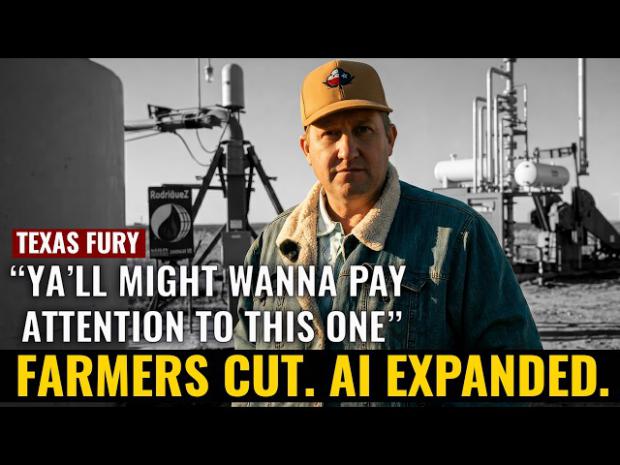
Kansas Cuts Farmers 20%. Texas Signs an AI Water Deal. Same Aquifer.
Two states.
One groundwater source.
Two completely different futures.
Kansas is ordering farmers to cut irrigation by 20% to slow depletion of the Ogallala Aquifer.
Meanwhile, in Texas, long-term water contracts are being signed to supply AI data centers — infrastructure designed to power the digital economy.
Same aquifer.
Different priorities.
This isn't a story about drought panic.
It's a story about allocation.
As artificial intelligence expands, so does its physical footprint — data centers require enormous volumes of water for cooling. At the same time, agricultural producers across the High Plains are being asked to scale back to preserve long-term supply.
So the question becomes:
Who decides where the water goes?
In this episode of The Rural Shift, we examine:
The Ogallala Aquifer's depletion trajectory
State-level conservation mandates in Kansas
Texas water contracts tied to AI infrastructure
The growing collision between digital expansion and food production
What this means for long-term rural economic stability
This is not anti-technology.
It is not anti-agriculture.
It's about structural prioritization.
When scarcity meets policy, someone absorbs the cost.
And increasingly, rural America feels it first.