










Breaking News
 Iran – The 'Ragtag Network of Activists' Run by the State Department
 Virginia Democrats Take Office, Immediately Set Sights on Second Amendment
 The day of the tactical laser weapon arrives
 Ilhan Omar is under investigation for her skyrocketing wealth... as she berates reporters...
Top Tech News
 Solar Just Took a Huge Leap Forward!- CallSun 215 Anti Shade Panel
 XAI Grok 4.20 and OpenAI GPT 5.2 Are Solving Significant Previously Unsolved Math Proofs
 Watch: World's fastest drone hits 408 mph to reclaim speed record
 Ukrainian robot soldier holds off Russian forces by itself in six-week battle
 NASA announces strongest evidence yet for ancient life on Mars
 Caltech has successfully demonstrated wireless energy transfer...
 The TZLA Plasma Files: The Secret Health Sovereignty Tech That Uncle Trump And The CIA Tried To Bury
 Nano Nuclear Enters The Asian Market
 Superheat Unveils the H1: A Revolutionary Bitcoin-Mining Water Heater at CES 2026
 World's most powerful hypergravity machine is 1,900X stronger than Earth



The day of the tactical laser weapon arrives
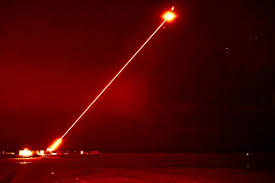
When the invention of the laser by Theodore Maiman at the Hughes Research Laboratories was made public on July 7, 1960, the press immediately saw the military possibilities, with the Los Angeles Herald proclaiming "LA Man Discovers Science-Fiction Death Ray."
In the months and years that followed, popular media would often talk about the destructive potential of lasers with the Associated Press publishing an article that proclaimed that a satellite armed with a laser could control the Earth. Concepts of laser weapons were common while thrillers like 1964's Goldfinger cemented the concept of the laser weapon in the public's mind.
However, reality was very, very far behind. For years the laser was infamous as the solution in search of a problem and although lasers could be spectacular, they were hardly weapons-grade in the 1960s. Just look at the fact that the power of the laser then was measured in Gillettes. That is, how many razor blades a laser beam could cut through at one time.
Even as the laser found applications in science and technology, giving rise to miracle surgery and revolutionary communications, lasers mainly found military applications as targeting systems and range finders. The only real laser weapon that saw service during the 20th century was a low-power laser used by the Royal Navy during the 1982 Falklands War to temporarily dazzle and distract enemy pilots.
Not that this was due to lack of trying. Both the US and the Soviet Union had ambitious programs to develop laser weapons. The Americans even modified a Boeing 747 to carry a huge experimental and alarmingly dangerous chemical laser designed to shoot down intercontinental ballistic missiles that was more of a menace to the crew than the missiles.
In the past two decades the development of a new generation of lasers began to change all this. The basic problem was three fold. First, figure out how to make a laser with enough power to be practical. Second, learn how to seek targets. Third, how to adjust the beam to compensate for atmospheric effects.
The breakthrough was the development of solid-state lasers that use bundles of glass fibers doped with exotic elements like ytterbium, erbium, and thulium along with aluminum, germanium, and phosphorus. These curled up bundles allowed for very long, efficient lasers to be stuffed into very small volumes and new technologies allowed multiple lasers to be combined into a single, far more powerful beam.
At the business end, new targeting systems were developed to identify and lock onto targets quickly. Along with this came systems that used things like reference lasers to analyze the air between the weapon and target so the deadly beam could be altered to compensate for any distortion.