










Breaking News
 Mike Benz just examined Epstein files and he's got a telltale theory…
 The Ever-Widening War
 BREAKING GLOBAL EXCLUSIVE: Former High-Level CIA Operative Patrick Byrne Reveals That...
 Junk-food Bans for SNAP Users To Begin in January
Top Tech News
 EngineAI T800: Born to Disrupt! #EngineAI #robotics #newtechnology #newproduct
 This Silicon Anode Breakthrough Could Mark A Turning Point For EV Batteries [Update]
 Travel gadget promises to dry and iron your clothes – totally hands-free
 Perfect Aircrete, Kitchen Ingredients.
 Futuristic pixel-raising display lets you feel what's onscreen
 Cutting-Edge Facility Generates Pure Water and Hydrogen Fuel from Seawater for Mere Pennies
 This tiny dev board is packed with features for ambitious makers
 Scientists Discover Gel to Regrow Tooth Enamel
 Vitamin C and Dandelion Root Killing Cancer Cells -- as Former CDC Director Calls for COVID-19...
 Galactic Brain: US firm plans space-based data centers, power grid to challenge China



Europe's Farmer Protests Are A Warning America Can't Ignore
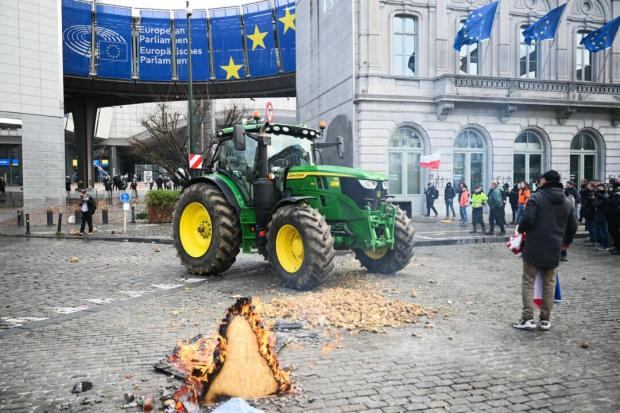
Yes, I speak publicly—on podcasts, from stages, and in print—about better ways to grow food.
But I never villainize farmers. Not conventional farmers. Not farmers locked into systems they did not design. Not farmers working with razor-thin margins, massive equipment debt, weather risk, and policy pressure stacked against them.
No one wants to be the generation that loses the farm.
And yet that is exactly what is unfolding across Europe right now...and quietly, steadily, in the United States as well.
Over the past two years, farmers across Europe have mobilized at a scale that should dominate headlines. Instead, it has been treated as background noise.
In the Netherlands, farmers have protested nitrogen rules that would force mass farm closures—even among low-input and regenerative operations. In France, farmers have blocked highways and surrounded Paris with tractors, protesting fuel taxes, land-use restrictions, and impossible compliance burdens. In Germany, tens of thousands of farmers drove tractors into Berlin over the removal of diesel tax exemptions that many farms rely on to survive. In Belgium, farmers dumped produce and manure outside EU buildings in Brussels. In Poland, Romania, and Hungary, farmers have protested cheap imports and regulations that apply to domestic producers but not foreign competitors.
These are not isolated events. They are sustained, multinational protests by people who feed entire continents.
And yet the coverage is minimal, fleeting, or framed as an inconvenient disruption rather than an existential warning.
European farmers are not protesting environmental responsibility. Many already practice conservation, reduced inputs, rotational grazing, cover cropping, and soil-building methods.
What they are rejecting is regulation divorced from reality.
Under policies driven by the European Union and initiatives like the European Green Deal, farmers face rules that impose arbitrary nitrogen caps per acre, treat synthetic nitrogen and organic nitrogen as if they are identical, require land to be taken out of production regardless of local context, and demand extensive reporting and compliance that small and mid-size farms cannot absorb.
This is no longer about practices. There are fully regenerative farmers—no chemicals, integrated livestock, biologically active soils—who are still being regulated to death.