










Breaking News
 This Is The Most Energy-Rich Molecule In The World
 Jimmy Dore Compares Trump's Endorsement of Overthrowing Libya to His Actions in Venezuela
 Pfizer mRNA Found in Over 88% of Human Placentas, Sperm, and Blood -- and in 50% of Unvaccinated...
 "All real footage, no CGI, no AI, no video speed-up." Looks fake to me – their robot…
Top Tech News
 Build a Greenhouse HEATER that Lasts 10-15 DAYS!
 Look at the genius idea he came up with using this tank that nobody wanted
 Latest Comet 3I Atlas Anomolies Like the Impossible 600,000 Mile Long Sunward Tail
 Tesla Just Opened Its Biggest Supercharger Station Ever--And It's Powered By Solar And Batteries
 Your body already knows how to regrow limbs. We just haven't figured out how to turn it on yet.
 We've wiretapped the gut-brain hotline to decode signals driving disease
 3D-printable concrete alternative hardens in three days, not four weeks
 Could satellite-beaming planes and airships make SpaceX's Starlink obsolete?
 First totally synthetic human brain model has been realized
 Mach-23 potato gun to shoot satellites into space


3D Printed Aluminum Alloy Sets Strength Record on Path to Lighter Aircraft Systems
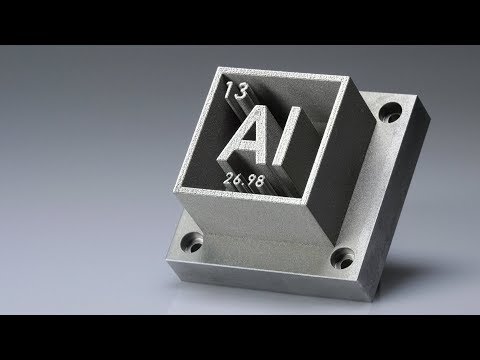
The new printable metal can withstand high temperatures and is five times stronger than traditionally manufactured aluminum.
It's made from a mix of aluminum and other elements that the team identified using a combination of simulations and machine learning, which significantly pruned the number of possible combinations of materials to consider to 40—before identifying an ideal mix.
The team then printed the alloy and tested the resulting material, soon confirming that, as predicted, the aluminum alloy was as strong as any manufactured today.
The researchers envision that the new printable aluminum could be made into stronger, more lightweight and temperature-resistant products, such as fan blades in jet engines. Fan blades are traditionally cast from titanium — a material that is more than 50 percent heavier and up to 10 times costlier than traditional aluminum.
"If we can use lighter, high-strength material, this would save a considerable amount of energy for the transportation industry," says Assistant Carnegie Mellon University Professor Mohadeseh Taheri-Mousavi, who led the work at MIT.
"Because 3D printing can produce complex geometries, save material, and enable unique designs, we see this printable alloy as something that could also be used in advanced vacuum pumps, high-end automobiles, and cooling devices for data centers," adds John Hart, who was head of the Department of Mechanical Engineering at MIT.
Hart and Taheri-Mousavi provide details on the new printable aluminum design in a paper published in the journal Advanced Materials.
Micro-sizing
The new work grew out of an MIT class Taheri-Mousavi took in 2020 in the Department of Materials Science and Engineering where he learned to use computational simulations to design high-performance alloys using a mix of different elements.