










Breaking News
 'UNFAIR': Mamdani's city-run grocer plan SLAPPED with lawsuit
 Trump Says If Iran Had a Nuclear Weapon, He Would Have Politely Called the Supreme Leader...
 Tucker Carlson: We are on the brink of a world war that ends with the use of nuclear weapons
 Who is trying to destroy the United States and the world?
Top Tech News
 Freezable titanium plate keeps your cooler chilled way longer than ice packs
 Review: Affordable thermal device is made for discovering life outdoors
 AI Whistleblower Tells Tucker How AI Could Kill All Humans by 2040
 You Hate Flock? Well There's More...
 Will Spiking Diesel Prices Drive Autonomous Trucking?
 Chinese Concept Video Imagines the Future of Warfare
 OPTIMUS CONFIRMED: 15,000 Bots This Year -- Tesla to $3,000
 What is Going On With Robotaxi and Cybercab? Here Are All the Answers
 Floating data center would provide water and electricity to 32,000 homes
 OpenAI Cuts Off Elon's Cursor, Humanity's First Star Probe, and Trump's Nuclear Mars Shi



Who Needs a Pilot? This New Autonomous Air Taxi Can Fly Passengers Hundreds of Miles
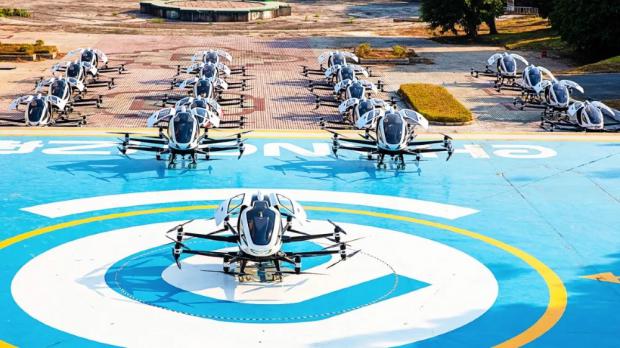
The fastest electric air-taxi to market is probably a name you've never heard before. In 2023, Chinese electric aviation company EHang certified its two-person, autonomously piloted EH216-S in China, paving the way for its use as a low-flying vehicle mainly used for local tourism. Six months after it received certification, it received permission to start wholesale production. Last April, it started doing limited tourism flights in Guangzhou and Hefei. According to a recent report, China plans to have more than 100,000 electric air taxis and cargo drones flying in its "low-altitude economy" by 2030.
For EHang, the two-person aircraft EH-216-S is just the start. The company has announced a partnership with the local Hefei government to launch its VT35, a longer-range, two-person autonomous air taxi based on the prototype VT30.
The new eVTOL marks EHang's move into the long-range air-taxi segment against competitors such as Archer, Joby, and Vertical Aerospace. Publicly traded Archer and Joby have said that they both expect to have their vehicles certified and in limited commercial use by the end of 2025 in Dubai and Abu Dhabi in the United Arab Emirates. China plans to have over 100,000 air taxis flying by 2030.