










Breaking News
 This is the future we shall bring into being
 Elon Musk's Vision For The Future Looks Like A Movie
 Phosphorus Munitions Fired by Israel Burn Groves, Orchards in Southern Lebanon
 Iran's IRGC Warns It Will Expand 'Geography of the War' If the US Attacks Again
Top Tech News
 BEYOND THE MOON: NASA plans a nuclear-powered fleet to push DEEPER into space
 Big Oil Backs Mazama's $135 Million Bet On Superhot Geothermal
 Quantum compass takes flight on Northrop's Lumberjack drone
 Terrifying AI Behavior Even Its Creators Couldn't Explain
 WW3 Near-Miss? AI Hallucinated Nuclear Weapons Components Aboard Chinese Vessel Bound For Iran
 Stripe Is Building the Toll Road for the Machine Economy
 Toyota Dakar hopeful swaps twin-turbo V6 for hydrogen fuel cells
 4-min turbo-inflatable cubic camp castle is now available in the USA
 Researchers Used Claude To Hack OpenAI Employee Accounts
 Chinese Scientists Develop New Oil Refining Method That Cuts Energy Use by 90%



China's 'Artificial Sun' Brings Nuclear Fusion One Step Closer, Breaking World Record
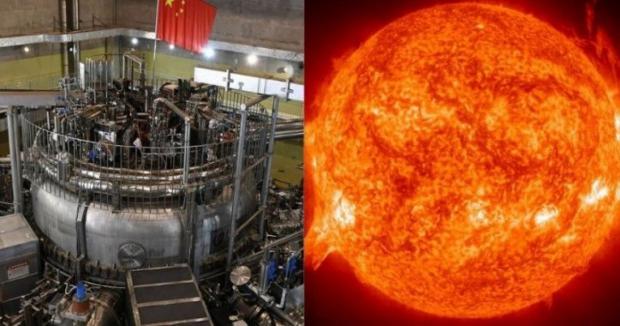
In its quest to develop unlimited green energy, the EAST Fusion Facility in Heifei, China recently created a plasma gas that was heated to 120° million Celsius—that's three-times hotter than the sun—and kept it there for 101 seconds before it dissipated, setting a new world record both for heat and duration.
"The breakthrough is significant progress, and the ultimate goal should be keeping the temperature at a stable level for a long time," said Li Mao, director of physics at Southern University of Sci-Tech in Shenzhen.
The previous record was 50° million Celsius, held by the scientists working at the fusion reactor in South Korea.
Flying cars, jetpacks, bullet trains—there are a lot of classic Sci-fi tech landmarks that we've reached, but a nuclear fusion reactor, essentially an artificial sun, is currently just considered plausible.
Borrowing the physics from reactions in the center of the sun, a thermonuclear fusion reactor squeezes hydrogen into helium, creating a dream of unlimited green energy, as the amount of deuterium, a version of hydrogen, found in 1 liter of seawater could produce as much energy as 300 liters of gasoline.