










Breaking News
 'UNFAIR': Mamdani's city-run grocer plan SLAPPED with lawsuit
 Trump Says If Iran Had a Nuclear Weapon, He Would Have Politely Called the Supreme Leader...
 Tucker Carlson: We are on the brink of a world war that ends with the use of nuclear weapons
 Who is trying to destroy the United States and the world?
Top Tech News
 NASA Super Light Solar Sail Project Will Be 12-40 Times Lighter and Faster
 Space Telescope Interferometer to Image Exoplanet Continents
 Twenty-five years of "temporary": how 9/11 built a surveillance state Americans never vote
 I'll Never Buy Another WALMART Battery!
 Shoei GT-Air 3 Smart helmet drops with built-in AR for $1,500
 Freezable titanium plate keeps your cooler chilled way longer than ice packs
 Review: Affordable thermal device is made for discovering life outdoors
 AI Whistleblower Tells Tucker How AI Could Kill All Humans by 2040
 You Hate Flock? Well There's More...
 Will Spiking Diesel Prices Drive Autonomous Trucking?



Cyclotech brings a totally unique propulsion system to the eVTOL world
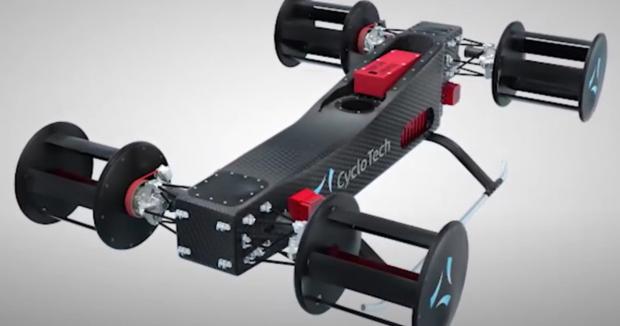
The prop design, which looks a bit like it belongs on the back of an 1850s paddle steamer, was patented nearly 100 years ago but hasn't made it into a production aircraft yet. Each prop is a spinning cylinder whose walls are formed by a number of wing blades.
The secret to the agility of this "Cyclogyro" arrangement is analogous to the way helicopter blades work, continuously altering the angle of the blades as they spin to adjust and direct lift using a "swashplate." In the Cyclogyro arrangement, a mechanical linkage – conrods connected to a central hub – is able to tilt and angle the wing blades as they spin around the cylinder, tilting them gradually into the wind as they reach a certain point in their rotation, and then gradually back to flat as they pass the peak point.
The ability to quickly move that hub and redirect thrust makes this an exceptionally fast-responding system compared to the rest of the eVTOL market, which all need to apply torque and spin rotors up to get the job done. And unlike traditional prop-driven designs, each Cyclogyro's thrust can be directed in any direction on its rotational axis – forward, backward, up, down and anything in between – nearly instantly. So its ability to spin on a dime will be pretty epic if you're looking for a next-generation vomitron.