










Breaking News
 'UNFAIR': Mamdani's city-run grocer plan SLAPPED with lawsuit
 Trump Says If Iran Had a Nuclear Weapon, He Would Have Politely Called the Supreme Leader...
 Tucker Carlson: We are on the brink of a world war that ends with the use of nuclear weapons
 Who is trying to destroy the United States and the world?
Top Tech News
 NASA Super Light Solar Sail Project Will Be 12-40 Times Lighter and Faster
 Space Telescope Interferometer to Image Exoplanet Continents
 Twenty-five years of "temporary": how 9/11 built a surveillance state Americans never vote
 I'll Never Buy Another WALMART Battery!
 Shoei GT-Air 3 Smart helmet drops with built-in AR for $1,500
 Freezable titanium plate keeps your cooler chilled way longer than ice packs
 Review: Affordable thermal device is made for discovering life outdoors
 AI Whistleblower Tells Tucker How AI Could Kill All Humans by 2040
 You Hate Flock? Well There's More...
 Will Spiking Diesel Prices Drive Autonomous Trucking?



Where Will EV Charging Stations Of The Future Be Located?
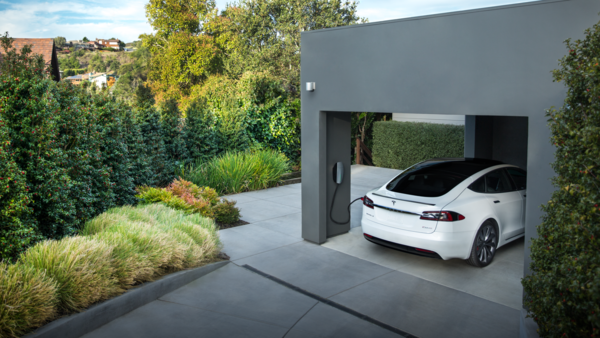
DRIVEWAYS, NOT GAS STATIONS, ARE THE EV FUELING STATIONS OF THE FUTURE
The adoption of any new technology is a gradual process, and it always takes time for people to break free of their old ways of doing things. Early TV shows were basically filmed radio plays, and early web sites looked like magazine pages with hyperlinks. Today, even as visionaries are visualizing a world in which transportation runs on electricity, many people can't let go of the gas station paradigm. In 2017, a USB auto analyst and Tesla skeptic took this short-sightedness to a ludicrous level when he speculated that Tesla would need to deploy 30,000 Superchargers (at a cost of $8 billion) "to match the convenience of the US gas infrastructure."
*This article comes to us courtesy of EVANNEX (which also makes aftermarket Tesla accessories). Authored by Charles Morris. The opinions expressed in these articles are not necessarily our own at InsideEVs.
 |
Above: Tesla Model S charging at home (Source: Tesla)
Of course, EV owners instantly saw the absurdity (and mercilessly ridiculed the poor square online). Most charging takes place at home, and one of the joys of EV ownership is never again having to visit a gas station.
Industry experts disagree about how much and what kinds of infrastructure will be needed in the EV ecosystem of the future, but there's no question that public charging will have a role to play. As Tesla understood from the beginning, drivers need to make long road trips, so highway fast chargers like the Supercharger network are a necessity. There's also the question of drivers who live in apartments with no dedicated parking spaces.
Management consulting firm McKinsey & Company has published a number of studies examining the coming transition to e-mobility. In a recent blog post, Hauke Engel, a partner with the McKinsey Center for Future Mobility, offers some thoughtful insights into the future of EV charging. "The vast majority of EV owners in the U.S. will likely charge in their own driveways," Engel writes, noting that "driveway and garage car charging is cost-effective because it uses off-peak residential, as opposed to commercial, electricity prices. This prediction is supported by McKinsey's own forecast of zip-code-level EV penetration data: suburbs will emerge as hot spots for early EV adopters."
 |