










Breaking News
 "Begin Preparing Yourself..." - Jeffrey Sachs
 The 5-Year Treasury Just Broke 5%... The Whole Curve Is Next
 ICE Denounced for Enacting 'Official Government Policy of Disappearing People'
 Google Just Told Canadian Adults: Give Us Your ID and a Selfie Or Else…And It's Starting Now!!
Top Tech News
 Tesla Model 3 killer charges from 10 to 97% in just 9 minutes
 World-first unpowered DNA computer sets speed record
 I Power 5 Buildings Off-Grid. Here's How
 The US government is pushing hard to get a working nuclear fission reactor into space by late 2028
 SpaceX Starmind AI in Space Radiator
 China Will Dominate Global Nuclear Energy Through 2035, Analyst Says
 These Absolutely Wild-Looking EVs Are Saudi Arabia's First Homegrown Cars
 BEYOND THE MOON: NASA plans a nuclear-powered fleet to push DEEPER into space
 Big Oil Backs Mazama's $135 Million Bet On Superhot Geothermal
 Quantum compass takes flight on Northrop's Lumberjack drone


A 'smart' toilet could stop us from flushing away our most valuable health information...
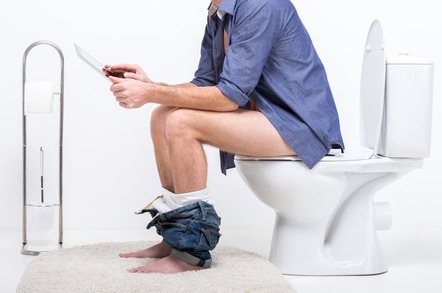
*"Smart toilets" that track health could do a lot for patients, but so far we haven't seen the technology hit the mainstream.
*It's desperately needed, says this gastroenterologist-in-training.
*Let's stop flushing away vital health information.
Sameer Berry is currently a third-year resident physician at Cedars-Sinai Medical Center in Los Angeles.
As a gastroenterologist-in-training, here's an innovation I could use: A "smart" toilet.
What do I mean by that? Well, I'm not referring to those comfort-focused toilets with warm-water washing, air drying, and heated seats have been ubiquitous in Japan (and at Google's headquarters) for years. And I'm not talking about the hygiene-focused toilets that made recent news when Bill Gates announced a $200 million investment in toilet design to convert human waste into useable fertilizer and clean water. Although the latter is useful and needed, as the the improved sanitation could reduce infant deaths by 50,000 and save billions of dollars annually.
The smart toilet I'm referring to is a health-tracking toilet.
In my gastroenterology fellowship, I will treat diseases of the gut. I'd love to see the next generation of medical-technologists designing hardware with features to monitor and diagnose gastrointestinal disease. It's a hard problem for all sorts of reasons, but both doctors and patients could benefit if we figure out a way to stop flushing away some of our most vital health information.
The need for a "smart toilet"
Doctors realize that our patients will spend 99 percent of their time outside of our office. Yet most of the data we use to make decisions about their care is collected irregularly in clinics or hospitals.
In my view, understanding the status of a patient's day-to-day health outside of the clinic is key to having a holistic assessment of well-being and therefore delivering better care.
We've seen a lot of wearable devices emerge in the past decade. And the most recent crop of them are attempting to bridge this data gap by sharing medical information with physicians that goes beyond steps and calories. One example is AliveCor, which can record a medical-grade electrocardiogram (EKG) from a patient's smartphone to help detect abnormal heart rhythms. These medical technologies are aiming to get a better sense of people's health outside of the 0.1 percent of the patient's life spent in our office.
But so far, we don't have an equivalent technology for the human gut.
I see a big opportunity to apply these innovations in areas where patients feel a lot of stigma -- and bowel habits is a big one. It's also arguably among the most impactful and actionable data.