










Breaking News
 This is the future we shall bring into being
 Elon Musk's Vision For The Future Looks Like A Movie
 Phosphorus Munitions Fired by Israel Burn Groves, Orchards in Southern Lebanon
 Iran's IRGC Warns It Will Expand 'Geography of the War' If the US Attacks Again
Top Tech News
 BEYOND THE MOON: NASA plans a nuclear-powered fleet to push DEEPER into space
 Big Oil Backs Mazama's $135 Million Bet On Superhot Geothermal
 Quantum compass takes flight on Northrop's Lumberjack drone
 Terrifying AI Behavior Even Its Creators Couldn't Explain
 WW3 Near-Miss? AI Hallucinated Nuclear Weapons Components Aboard Chinese Vessel Bound For Iran
 Stripe Is Building the Toll Road for the Machine Economy
 Toyota Dakar hopeful swaps twin-turbo V6 for hydrogen fuel cells
 4-min turbo-inflatable cubic camp castle is now available in the USA
 Researchers Used Claude To Hack OpenAI Employee Accounts
 Chinese Scientists Develop New Oil Refining Method That Cuts Energy Use by 90%



Bleached-white nanowood material promises exceptional insulating properties
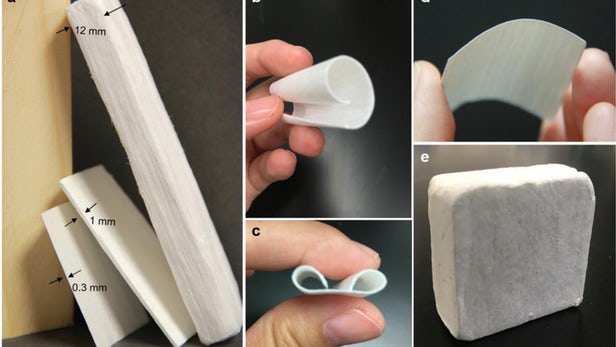
"Nanowood" as the team calls it, is produced by taking certain cuts of regular wood –American basswood in initial trials – and chemically removing all the lignin from it. Lignin contributes the yellow/brown color and hardness you'd normally associate with wood. It's removed entirely when making perfectly white paper that doesn't yellow as it ages.
In fact, the process for producing nanowood is very similar to making paper – the wood is cut, paying special attention to its grain, and then it's boiled in sodium hydroxide and sodium sulfite, then treated in hydrogen peroxide to remove lignin and most of the hemicellulose, and then freeze-dried to maintain the structure of the wood, instead of mashed up as you would to produce paper.
With the lignin taken out of a block of wood, what you're left with is a lightweight, white bundle of cellulose fibers – the scaffold-like structure of the wood itself.
These fibers not only act as extremely effective insulators that are significantly better at blocking heat than the styrene- or silica-based materials typically used in home insulation, but their tubular shape also gives them anisotropic properties. Heat can conduct fairly freely in line with the fibers, but is very effectively blocked in any other direction. So designers can use this property to channel heat around the place as they see fit, and block it elsewhere, just by changing the orientation of the nanowood fibers.