










Breaking News
 Iran Announces Fuel Rationing As Brent Sets New War Highs, After Trump Rejects Tehran's Latest O
 BREAKING: James Comey Under Arrest – Surrenders to Law Enforcement at Federal Courthouse...
 Founding Felons: Jefferson Would Be on a Watch List Today--You Might Be Next
 If Science Is a Public Good, Let China Pay for It
Top Tech News
 Researcher wins 1 bitcoin bounty for 'largest quantum attack' on underlying tech
 Interceptor-Drone Arms-Race Emerges
 A startup called Inversion has introduced Arc, a space-based vehicle...
 Mining companies are using cosmic rays to find critical minerals
 They regrew a severed nerve - by shortening a bone.
 New Robot Ants Work Like Real Insects To Build And Dismantle On Their Own
 Russian scientists 'are developing the world's first drug to delay ageing' months after
 Sam Altman's World ID Expands Biometric Identity Checks
 China Tests Directed Energy Beam That Recharges Drones Mid-Flight
 Jurassic Park might arrive sooner than expected, just with Dinobots.



Rise of the AI-rport robots! Japan Airlines is using humanoid baggage handlers to load luggage...
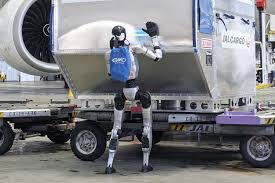
Lost luggage and battered bags could soon be a thing of the past, as Japan Airlines starts testing robotic baggage handlers.
Starting in May, human workers at Tokyo's busy Haneda airport will have a helping hand from an army of humanoid robots as part of a two–year trial.
The Chinese–made bots will be trained to tackle ground handling tasks like loading cargo containers of luggage on and off flights.
Japan Airlines (JAL) hopes that the new robotic workers will help ease staffing issues as Japan juggles a surge in tourism and a slumping workforce.
The airport will trial two robots: the child–sized 130cm Unitree G1, and the larger 172cm UBTech Walker E, according to Aviation Wire.
In a demonstration for the media, a Unitree G1 was seen gently, if a little unsteadily, nudging a cargo container onto a conveyor belt.
While this display of dexterity might not be that impressive, JAL is confident that robots will start replacing humans in some areas as early as 2028.
Yoshiteru Suzuk, the president of JAL's Ground Service, told reporters that using robots for the heavy lifting will 'provide significant benefits to employees'.
The two–year trial will initially focus on teaching the robots how to complete each physically demanding task, breaking it down into a series of movements.
Once the robots have figured out how to load and unload the bulky cargo containers, they will be able to start working in the airport's ground services team.
JAL says that they expect the robots to be a real part of the workflow at Haneda airport, which handles more than 60 million passengers a year, by late 2027.
If the trial is a success, the robots will then become a permanent part of the airport's workflow.
Eventually, the robots are expected to be used across a wide range of tasks, including loading baggage, cabin cleaning, and even operating GSE ground support equipment like tugs and refuelers.
While the robots won't be able to handle duties such as safety management, JAL believes the humanoids are needed to tackle its workforce woes.
Tomohiro Uchida, president of GMO AI & Robotics, which has partnered with JAL for the project, told reporters: 'While airports appear highly automated and standardised, their back–end operations still rely heavily on human labour and face serious labour shortages.'