










Breaking News
 Xi backs AI safety with Trump, draws Taiwan line, urges Iran talks
 The Israeli Lobby Boasts of Its Rule of America
 Dan Priestly and Lars Lead the Tesla Semi Event
 Russia and China have a plan to disable Starlink
Top Tech News
 Tesla Model 3 killer charges from 10 to 97% in just 9 minutes
 World-first unpowered DNA computer sets speed record
 I Power 5 Buildings Off-Grid. Here's How
 The US government is pushing hard to get a working nuclear fission reactor into space by late 2028
 SpaceX Starmind AI in Space Radiator
 China Will Dominate Global Nuclear Energy Through 2035, Analyst Says
 These Absolutely Wild-Looking EVs Are Saudi Arabia's First Homegrown Cars
 BEYOND THE MOON: NASA plans a nuclear-powered fleet to push DEEPER into space
 Big Oil Backs Mazama's $135 Million Bet On Superhot Geothermal
 Quantum compass takes flight on Northrop's Lumberjack drone


Higher terahertz frequencies are usable for data transmission which will boost data 100...
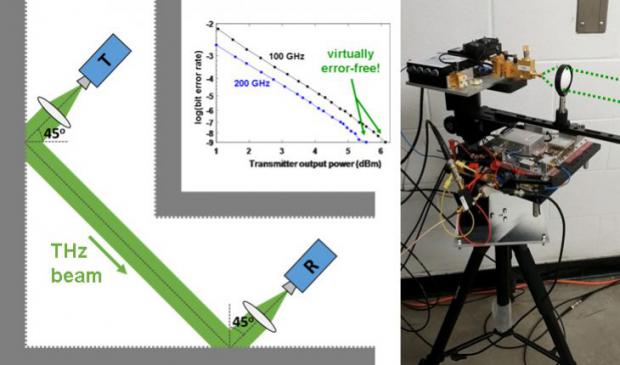
An off-the-wall new study by Brown University researchers shows that terahertz frequency data links can bounce around a room without dropping too much data. The results are good news for the feasibility of future terahertz wireless data networks, which have the potential to carry many times more data than current networks.
Today's cellular networks and Wi-Fi systems rely on microwave radiation to carry data, but the demand for more and more bandwidth is quickly becoming more than microwaves can handle. That has researchers thinking about transmitting data on higher-frequency terahertz waves, which have as much as 100 times the data-carrying capacity of microwaves. But terahertz communication technology is in its infancy. There's much basic research to be done and plenty of challenges to overcome.
For example, it's been assumed that terahertz links would require a direct line of sight between transmitter and receiver. Unlike microwaves, terahertz waves are entirely blocked by most solid objects. And the assumption has been that it's not possible to bounce a terahertz beam around—say, off a wall or two—to find a clear path around an object.