










Breaking News
 Xi backs AI safety with Trump, draws Taiwan line, urges Iran talks
 The Israeli Lobby Boasts of Its Rule of America
 Dan Priestly and Lars Lead the Tesla Semi Event
 Russia and China have a plan to disable Starlink
Top Tech News
 Tesla Model 3 killer charges from 10 to 97% in just 9 minutes
 World-first unpowered DNA computer sets speed record
 I Power 5 Buildings Off-Grid. Here's How
 The US government is pushing hard to get a working nuclear fission reactor into space by late 2028
 SpaceX Starmind AI in Space Radiator
 China Will Dominate Global Nuclear Energy Through 2035, Analyst Says
 These Absolutely Wild-Looking EVs Are Saudi Arabia's First Homegrown Cars
 BEYOND THE MOON: NASA plans a nuclear-powered fleet to push DEEPER into space
 Big Oil Backs Mazama's $135 Million Bet On Superhot Geothermal
 Quantum compass takes flight on Northrop's Lumberjack drone


This Electric Shuttle Charges In Just 20 Seconds
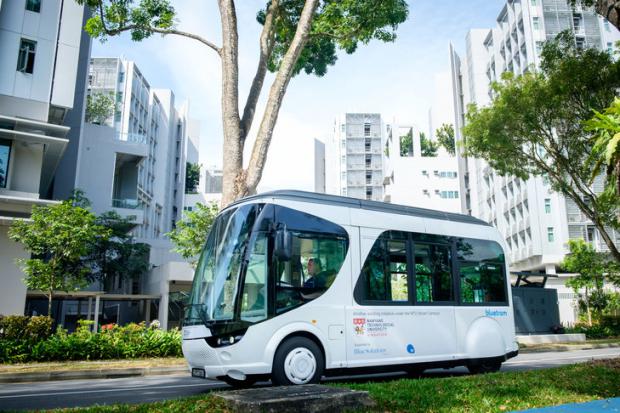
If the electric vehicles are to be the future, then so must be flash charging — the ability to replenish a flat battery in several short minutes. And like EVs, it's already happening. At least, in a limited sense.
The island city-state of Singapore can now boast a tram that recharges in a mere 20 seconds at proprietary stations along its route. While that sounds pretty amazing, the technical details reveal the limited nature of the vehicle's abilities. To be blunt, this tech will not find lead to your Jaguar iPace (to choose an EV at random) recharging in under a minute. Still, the tech could be a good fit for other transportation modes aside from personal vehicles.
The NTU-Blue Solutions Flash Shuttle, as it has been romantically christened, was just launched by Nanyang Technological University, (NTU Singapore) and BlueSG Pte Ltd, which is a subsidiary of Bolloré Group's Blue Solutions. As it stops to drop off passengers, it can flash charge its bank of supercapacitors in less than half a minute. This is enough juice to roll along for two kilometers (1.24 miles), though it does have a Blue Solutions lithium metal polymer (LMP) battery as well that it can lean on for an additional 30 kilometers (18.6 miles), should the need present itself.