










Breaking News
 The Download: GLOBAL WAR LOOMING, GOVERNMENT AT YOUR DOOR & DOCTORS...
 Episode 495: AI'S FREE PASS, NIH FINALLY WAKES UP & CHILDHOOD DEATH BOMBSHELL
 Xi backs AI safety with Trump, draws Taiwan line, urges Iran talks
 The Israeli Lobby Boasts of Its Rule of America
Top Tech News
 Tesla Model 3 killer charges from 10 to 97% in just 9 minutes
 World-first unpowered DNA computer sets speed record
 I Power 5 Buildings Off-Grid. Here's How
 The US government is pushing hard to get a working nuclear fission reactor into space by late 2028
 SpaceX Starmind AI in Space Radiator
 China Will Dominate Global Nuclear Energy Through 2035, Analyst Says
 These Absolutely Wild-Looking EVs Are Saudi Arabia's First Homegrown Cars
 BEYOND THE MOON: NASA plans a nuclear-powered fleet to push DEEPER into space
 Big Oil Backs Mazama's $135 Million Bet On Superhot Geothermal
 Quantum compass takes flight on Northrop's Lumberjack drone


Rigetti has a 19 qubit quantum computing system and it runs unsupervised machine learning
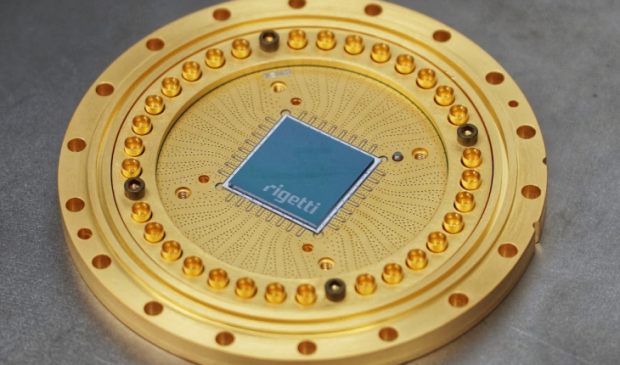
Arxiv – Unsupervised Machine Learning on a Hybrid Quantum Computer
Machine learning techniques have led to broad adoption of a statistical model of computing. The statistical distributions natively available on quantum processors are a superset of those available classically. Harnessing this attribute has the potential to accelerate or otherwise improve machine learning relative to purely classical performance. A key challenge toward that goal is learning to hybridize classical computing resources and traditional learning techniques with the emerging capabilities of general purpose quantum processors. Here, we demonstrate such hybridization by training a 19-qubit gate model processor to solve a clustering problem, a foundational challenge in unsupervised learning. We use the quantum approximate optimization algorithm in conjunction with a gradient-free Bayesian optimization to train the quantum machine. This quantum/classical hybrid algorithm shows robustness to realistic noise, and we find evidence that classical optimization can be used to train around both coherent and incoherent imperfections.