










Breaking News
 Walter Block Ejected From Mises Institute Over Defense Of Israel After October 7th
 The Permission Grid: A Blueprint for a Permanent Slave Class
 Banning The Export of Diesel Will Only Make A Bad Situation Worse
 SCARY, DARK, DIRECT, But Is It TRUE? You Decide
Top Tech News
 Tesla Model 3 killer charges from 10 to 97% in just 9 minutes
 World-first unpowered DNA computer sets speed record
 I Power 5 Buildings Off-Grid. Here's How
 The US government is pushing hard to get a working nuclear fission reactor into space by late 2028
 SpaceX Starmind AI in Space Radiator
 China Will Dominate Global Nuclear Energy Through 2035, Analyst Says
 These Absolutely Wild-Looking EVs Are Saudi Arabia's First Homegrown Cars
 BEYOND THE MOON: NASA plans a nuclear-powered fleet to push DEEPER into space
 Big Oil Backs Mazama's $135 Million Bet On Superhot Geothermal
 Quantum compass takes flight on Northrop's Lumberjack drone


SpaceX Launches 10 New Iridium Satellites, Sticks Rocket Landing
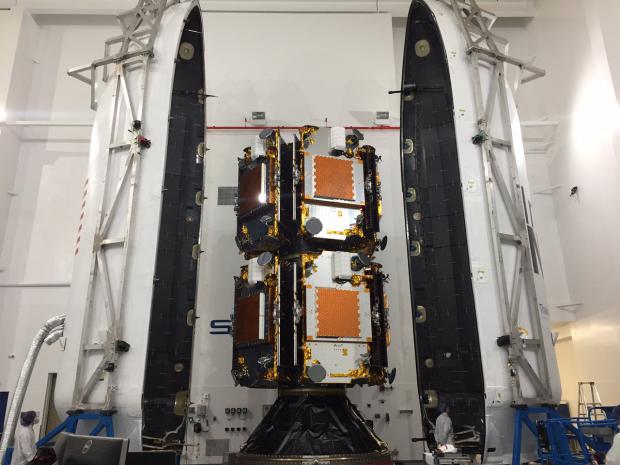
The private spaceflight company SpaceX successfully launched 10 communications satellites into low-Earth orbit today (Oct. 9) and landed the spent Falcon 9 first-stage rocket booster on a drone ship in the Pacific Ocean.
The SpaceX Falcon 9 rocket took off from Vandenberg Air Force Base in California at 8:37 a.m. EDT (1237 GMT/5:37 a.m. EDT), carrying 10 satellites for Iridium Communications, as part of the company's Iridium Next constellation. The first stage of the two-stage Falcon 9 landed on SpaceX's drone ship "Just Read the Instructions" in the Pacific about 7.5 minutes after the launch.
"Looks like we've got a good orbit," said John Insprucker, SpaceX's Falcon 9 principal integration engineer, just after the launch during live webcast commentary.
The Iridium Next satellites were deployed 57 minutes after liftoff, with the entire process taking about 15 minutes, according to a SpaceX flight plan.
"We're 10 for 10!" Insprucker said. "A clean sweep of Iridium Next satellite deployment in the desired final orbit."
The Iridium Next constellation will eventually consist of 66 primary satellites and nine on-orbit backup satellites. This is the third of eight scheduled SpaceX launches for the Iridium Next constellation, which brings the total number of satellites now in orbit up to 30.
Today was the first flight of this particular Falcon 9 first-stage booster, a company representative told Space.com. SpaceX has successfully flown Falcon 9 boosters that were previously used, and plans to use a pre-flown booster to launch another communications satellite into orbit on Wednesday (Oct. 11), from NASA's Launch Complex 39A at the Kennedy Space Center in Florida.
Today's mission also marked SpaceX's 14th launch this year and the 17th successful landing of a Falcon 9 first stage. SpaceX has been reusing Falcon 9 first stages and is pursuing fully reusable rockets in an effort to lower the cost of spaceflight.

A SpaceX Falcon 9 rocket first stage stands atop the drone ship "Just Read The Instructions" in the Pacific Ocean after successfully launching 10 Iridium Next satellites into orbit from California's Vandenberg Air Force Base on Oct. 9, 2017.
Credit: SpaceX
Iridium Communications announced earlier this week that it had begun testing and validating its Iridium Certus service, which will utilize the Iridium Nextsatellites to provide a "truly global broadband service" to its users, according to a statement from the company. The 66 satellites will spread out around the planet to provide service to remote regions of the globe, the company has said.
At an industry conference last spring, Iridium representatives discussed the ways that the satellite constellation could be used to better keep track of airplanes, particularly over open ocean where ground-based tracking systems are unavailable. The commercial service is expected to be available in the "early second quarter" of 2018, according to the statement.
Follow Calla Cofield @callacofield. Follow us @Spacedotcom, Facebook and Google+. Original article on Space.com.