










Breaking News
 Is Big Pharma Selling Postpartum Depression to New Moms?
 Make Men Men Again: Low T Is Now a National Defense Problem
 Druski: They're Lying To You About Overnight Success!
 $6.27 Diesel Just Hit Harvest. The Grocery Aisle Hasn't Felt It Yet.
Top Tech News
 Tesla Model 3 killer charges from 10 to 97% in just 9 minutes
 World-first unpowered DNA computer sets speed record
 I Power 5 Buildings Off-Grid. Here's How
 The US government is pushing hard to get a working nuclear fission reactor into space by late 2028
 SpaceX Starmind AI in Space Radiator
 China Will Dominate Global Nuclear Energy Through 2035, Analyst Says
 These Absolutely Wild-Looking EVs Are Saudi Arabia's First Homegrown Cars
 BEYOND THE MOON: NASA plans a nuclear-powered fleet to push DEEPER into space
 Big Oil Backs Mazama's $135 Million Bet On Superhot Geothermal
 Quantum compass takes flight on Northrop's Lumberjack drone


1,000 times more efficient nano-LED opens door to faster microchip
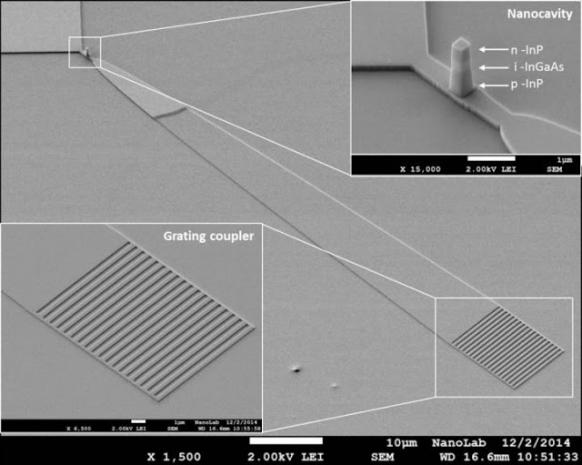
Optical connections are the obvious successors but optical data transmission requires an adequate nanoscale light source, and this has been lacking. Scientists at Eindhoven University of Technology (TU/e) now have created a light source that has the right characteristics: a nano-LED that is 1000 times more efficient than its predecessors, and is capable of handling gigabits per second data speeds. They have published their findings in the online journal Nature Communications.
With electrical cables reaching their limits, optical connections like fiberglass are increasingly becoming the standard for data traffic. Over longer distances almost all data transmission is optical. Within computer systems and microchips, too, the growth of data traffic is exponential, but that traffic is still electronic, and this is increasingly becoming a bottleneck. Since these connections ('interconnects') account for the majority of the energy consumed by chips, many scientists around the world are working on enabling optical (photonic) interconnects. Crucial to this is the light source that converts the data into light signals which must be small enough to fit into the microscopic structures of microchips. At the same time, the output capacity and efficiency have to be good. Especially the efficiency is a challenge, as small light sources, powered by nano- or microwatts, have always performed very inefficiently to date.