










Breaking News
 Is Big Pharma Selling Postpartum Depression to New Moms?
 Make Men Men Again: Low T Is Now a National Defense Problem
 Druski: They're Lying To You About Overnight Success!
 $6.27 Diesel Just Hit Harvest. The Grocery Aisle Hasn't Felt It Yet.
Top Tech News
 Tesla Model 3 killer charges from 10 to 97% in just 9 minutes
 World-first unpowered DNA computer sets speed record
 I Power 5 Buildings Off-Grid. Here's How
 The US government is pushing hard to get a working nuclear fission reactor into space by late 2028
 SpaceX Starmind AI in Space Radiator
 China Will Dominate Global Nuclear Energy Through 2035, Analyst Says
 These Absolutely Wild-Looking EVs Are Saudi Arabia's First Homegrown Cars
 BEYOND THE MOON: NASA plans a nuclear-powered fleet to push DEEPER into space
 Big Oil Backs Mazama's $135 Million Bet On Superhot Geothermal
 Quantum compass takes flight on Northrop's Lumberjack drone


Inside a photon prison, a light-and-matter hybrid is born
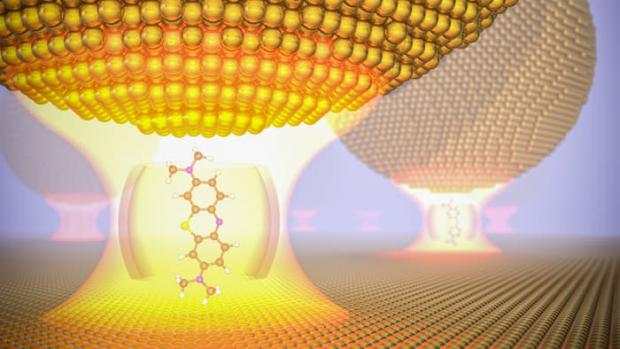
This unique mixture – or "strong coupling" – of light and matter, achieved for the first time at room temperature, will help scientists develop better on-chip communications, manipulate quantum information, or even tweak the chemical bonds of single molecules.
When we manipulate matter to produce light – be it by rubbing sticks to light a fire, heating a tungsten filament, or combining electric charges – photons normally leave their point of origin at the speed of light, never to return. But if those photons are somehow trapped and forced to interact with matter over and over (as was done in this study), light and matter can achieve "strong coupling," a unique hybrid state where a photon and a molecule are in a continuous interchange.
"It is a very strange interchange, indeed, because if you would compare the molecule and the light to a system such as tea and milk you would see the tea and the milk mixing when you pour the milk into the cup, but no-one would really expect that tea and milk would in time continuously de-mix and mix again," Prof. Ortwin Hess, the study's lead author, told Gizmag. "In the strongly coupled state, however, this happens to light and the molecule."