










Breaking News
 Is Big Pharma Selling Postpartum Depression to New Moms?
 Make Men Men Again: Low T Is Now a National Defense Problem
 Druski: They're Lying To You About Overnight Success!
 $6.27 Diesel Just Hit Harvest. The Grocery Aisle Hasn't Felt It Yet.
Top Tech News
 Tesla Model 3 killer charges from 10 to 97% in just 9 minutes
 World-first unpowered DNA computer sets speed record
 I Power 5 Buildings Off-Grid. Here's How
 The US government is pushing hard to get a working nuclear fission reactor into space by late 2028
 SpaceX Starmind AI in Space Radiator
 China Will Dominate Global Nuclear Energy Through 2035, Analyst Says
 These Absolutely Wild-Looking EVs Are Saudi Arabia's First Homegrown Cars
 BEYOND THE MOON: NASA plans a nuclear-powered fleet to push DEEPER into space
 Big Oil Backs Mazama's $135 Million Bet On Superhot Geothermal
 Quantum compass takes flight on Northrop's Lumberjack drone


Nanoscale lattice is world's smallest
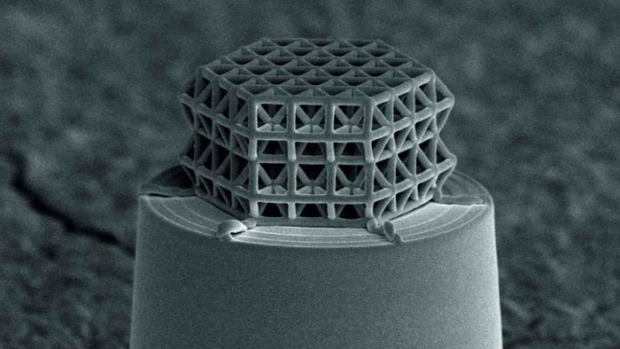
Formed with struts and braces measuring less than 10 micrometers in length and less than 200 nanometers in diameter, the 3D lattice has a total size of less than 10 micrometers, but boasts a higher specific strength than most solids.
The KIT team says the lattice achieves new strength to density ratios for metamaterials (man-made materials that have properties not found in nature), thanks to dimensions that are smaller than comparable metamaterials by a factor of five. It is made of glassy carbon, which is a form of pure carbon that boasts both glassy, ceramic properties and graphite properties.
Production of the lattice started with an established 3D lithography process, is which the structure is hardened in a photoresist by computer-controlled lasers. This process is limited to producing struts ranging from around 5 to 10 micrometers in length and 1 micrometer in diameter, so the team then vitrified and further shrunk the lattice through –in what they claim is a first for the manufacture of microstructured lattices – pyrolysis.