










Breaking News
 TEXAS SHATTERS MIDTERM EARLY VOTING RECORD
 Must-Watch Emergency Saturday Broadcast: Tune In Now & Learn What Is Really Behind The Global...
 The Next Metals Boom Belongs to Physical Owners
 And The Winner For Poorest Big City In America Is...
Top Tech News
 Microreactor Gets DOE Approval for Full Power Testing, Previously Contracts with Army...
 Ford Fathom: Everything We Know About The Sub-$30,000 Affordable EV Truck
 Love it or loathe it, AI is birthing a golden age of science
 SpaceX has no competition -- Saurav Shroff, Starpath
 Living computers forge a 'hive mind' and work together to outsmart AI
 The Faraday duffle bag: A digital lifeline in a surveillance-saturated world
 Delivery Robots Accused Of Scanning Customers' Faces, Sharing Biometric Data
 Brace Yourselves: Serious Trouble Brewing In The Data Center Industry
 FDA-Approval for Drill-Free Cavity Care May Be Imminent After Great Phase 3 Treatment Trial
 California Startup Says It Has Injected AI-Designed Virus Into Humans For First Time



Rubio Calls Out China's "Coercive Behavior" In West Sea As Japan, South Korea Sign Arc
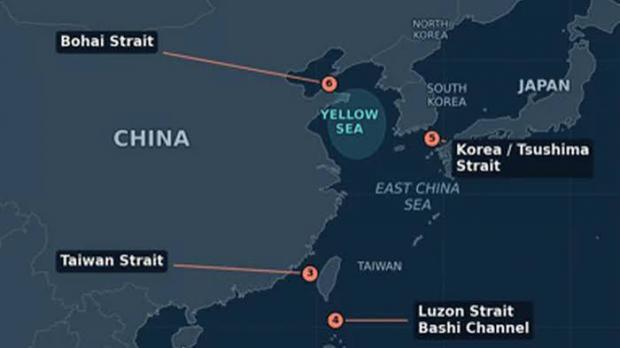
Secretary of State Marco Rubio raised concerns about China's efforts to assert control over the South China Sea, its "coercive behavior" in the East China Sea and Yellow Sea, and Russia-China cooperation that undermines peace and stability in the Indo-Pacific region, according to a State Department readout released Friday.
The meeting took place on the sidelines of the G20 in Atlanta on Friday, where Rubio and his counterparts discussed strengthening security and economic cooperation across the Indo-Pacific region. They also signed a memorandum establishing the Trilateral Arctic Pacific Partnership to explore maritime cooperation and economic opportunities in the Pacific Arctic.
South Korea's statement after the G20 meeting omitted references to China and the West Sea, saying only that the ministers discussed regional and global developments, including attempts to unilaterally change the status quo. Japan also said in a statement that it opposed force or coercion in the region, without naming Beijing or the disputed waters.
The Chosun Daily, a major South Korean newspaper, wrote, "This is the first time the U.S. Department of State has explicitly mentioned China's 'coercive behavior in the West Sea' while announcing the results of the South Korea-U.S.-Japan foreign ministers' meetings held four times this year."
The Trump administration's push to link maritime security, Arctic access and energy supply chains shows a much greater effort underway to coordinate with Japan and South Korea in response to China and Russia.
Behind the diplomatic language in the readout is one giant vulnerability: both U.S. allies depend on these critical maritime corridors, and it only takes one outbreak of regional instability or conflict to threaten energy supplies and industrial trade.
For the Arctic partnership, the key maritime chokepoint is the Bering Strait, the only maritime route between the Pacific and Arctic oceans. At about 53 miles wide, the chokepoint sits between Alaska and Russia, placing Arctic shipping directly between those two superpowers.
In the broader China story, the Taiwan and Malacca straits carry major trade risks. The Yellow Sea, which sits between China and the Korean Peninsula, is home to major ports and industrial zones.
More importantly, Japan and South Korea's dependence on these critical maritime corridors leaves both economies exposed to severe supply shocks. Disruptions in the Strait of Hormuz have shown this year just how much trouble can arise when a single chokepoint gets disrupted and how it can plunge energy markets and economies into turmoil.