










Breaking News
 Ultimately, the data center build-out is a story that goes beyond technological progress...
 The Collapse of Western Civilization Is Accelerating
 DIGITAL EUR FAIL: WHY LAGARDE IS EXITING EIGHT MONTHS EARLY
 RUSSIA'S NUCLEAR SIGNAL: A BULAVA MISSILE FIRED FROM BENEATH THE SEA OF OKHOTSK
Top Tech News
 Microreactor Gets DOE Approval for Full Power Testing, Previously Contracts with Army...
 Ford Fathom: Everything We Know About The Sub-$30,000 Affordable EV Truck
 Love it or loathe it, AI is birthing a golden age of science
 SpaceX has no competition -- Saurav Shroff, Starpath
 Living computers forge a 'hive mind' and work together to outsmart AI
 The Faraday duffle bag: A digital lifeline in a surveillance-saturated world
 Delivery Robots Accused Of Scanning Customers' Faces, Sharing Biometric Data
 Brace Yourselves: Serious Trouble Brewing In The Data Center Industry
 FDA-Approval for Drill-Free Cavity Care May Be Imminent After Great Phase 3 Treatment Trial
 California Startup Says It Has Injected AI-Designed Virus Into Humans For First Time



Microreactor Gets DOE Approval for Full Power Testing, Previously Contracts with Army...
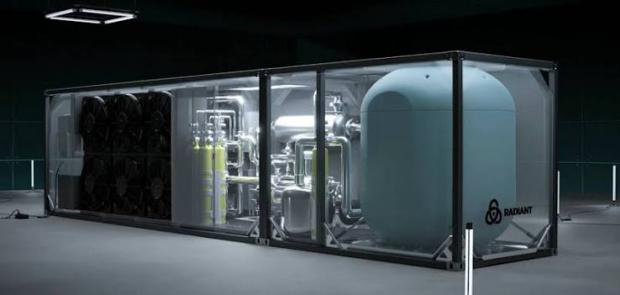
For the first time in American history, the Department of Energy has approved a commercial nuclear microreactor's safety analysis for full-power operations.
LA-based Radiant secured the approval, with testing planned at Idaho National Laboratory.
With the Kaleidos DSA approved, Radiant is cued for DOE's Readiness Review, which will assess whether Kaleidos and the team responsible for operating it are prepared to begin nuclear operations. Following successful completion of the review, Radiant will fuel Kaleidos and begin its five-phase test campaign at the National Reactor Innovation Center's Demonstration of Microreactor Experiments (DOME) facility at INL.
The campaign will progress from first criticality through increasingly higher-power operation, culminating in at least 150 hours of continuous operation at full power without operator intervention.
The approval follows DOE's February 2026 approval of Radiant's earlier Preliminary Documented Safety Analysis (PDSA) submission.
Radiant built Kaleidos at its El Segundo, California facility and shipped it to INL in August 2026. The DOME campaign is a key step toward Radiant's plan to manufacture Kaleidos at its R-50 facility in Oak Ridge, Tennessee, and deliver its first commercial units to Buckley Space Force Base and Fort Benning in 2028. Earlier this month, Radiant was selected by the U.S. Navy to deploy Kaleidos at Naval Weapons Station Crane in Indiana.
Radiant plans to deliver 15 reactors to the US military by 2030. Radiant has signed a commercial agreement with Equinix for 20 Kaleidos units and was selected by the Department of the Air Force and Defense Innovation Unit to develop and operate a microreactor at Buckley Space Force Base.
August 26, 2026 — Radiant, the company building the world's only plug-in ready, transportable commercial nuclear microreactors, today announced that the U.S. Army, in partnership with the Defense Innovation Unit (DIU), has executed a binding agreement totaling up to $750 million dollars to develop and deploy 15 Kaleidos nuclear microreactors through the Army's Janus Program. Radiant's award is one of the largest contracts ever issued by DIU across their portfolio, and the largest award within the Janus Program.
Kaleidos is a 1-megawatt nuclear microreactor, transportable by land, sea, or air and deployed directly at customer sites. Plug-in ready, each reactor provides up to five years of power before refueling and is engineered with a 20-year operating life cycle. Unlike permanently installed nuclear facilities that require long lead times and site-specific construction, Kaleidos provides energy in a box. It requires no cooling water, and it is not a "hole-in-the-ground" reactor. The reactor arrives as a sealed, fueled unit that can be plugged in immediately. Additional units can be added or relocated as energy requirements evolve. Radiant manages fueling, refueling, and spent-fuel storage at its own facilities, allowing customer sites to return to greenfield condition, within two years or less after a unit is removed. Customer sites never have onsite spent fuel storage.