










Breaking News
 Israel defense minister vows to keep troops in Syria during visit
 NASA engineer says white men did the grunt work while DEI hires got the careers… lawsuit incoming?
 AP goes full climate doomsday! 'The world inches toward catastrophic climate events':
 SpaceX Has 17 Starship Launch Pads Under Development
Top Tech News
 Singapore is experimenting with biological computing using living human neurons...
 It's Happening - Europe is Building an Impossible Fusion Reactor
 Portable 1MW Kaleidos Microreactor Secures Critical Nuclear Fuel Deal Through 2030s
 This New All-In-One Range Extender Is Ready To Go Into Any Electric Truck
 Aptera Reveals The Secret To Building Its Solar EV: China
 High-voltage sodium home battery emerges as affordable rooftop solar solution
 Peter Thiel-Funded Company Anduril to Triple the Number of Autonomous Surveillance...
 China has released Origin Pilot, claimed to be the world's first open-source operating system...
 ShieldAI XBAT Drone Fighters Can Give A Fighter Drone Wing to Every US Destroyer
 Brain organoids, kept alive more than five years, matured like human brains



AP goes full climate doomsday! 'The world inches toward catastrophic climate events':
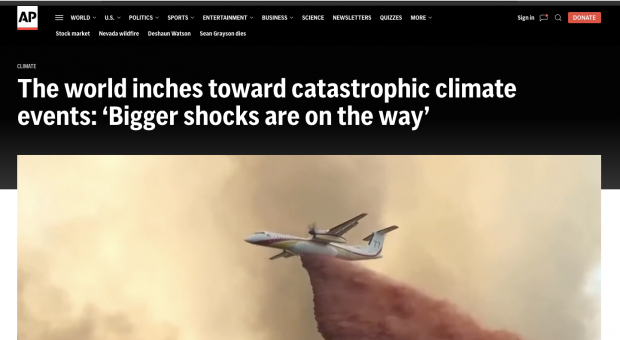
Scientists have long warned that the world will experience more intense extreme weather events like heat waves, storms, floods and droughts. But what once seemed like the realm of fiction is now discussed as a possibility, even an inevitability.
Warning about an "extreme of extremes" or the "Other Big One," a play off the California reference of a big future earthquake, can be fraught. After all, nobody can say for sure when a weather catastrophe may happen. But in the last few years, the planetary ingredients needed for a massive disturbance have been building. And alarm is growing.
"The risk is that people just think you are exaggerating," said Daniel Swain, a climate scientist with the California Institute for Water Resources. "It's the 'Boy Who Cried Wolf' problem. Sometimes wolves are real. If it's outside the door, wouldn't you want to know?"
Fast-forward: Today, Earth is being heated by massive amounts of greenhouse gases being pumped into the atmosphere, leading to a gradual rise in average global temperature. That increase, 1.44 degrees Celsius (2.59 degrees Fahrenheit) warmer in 2025 compared to the early 1800s, leads to more frequent, and more intense, extreme weather events. …
Sarah Perkins-Kirkpatrick, a climate scientist at Australian National University, says she had a "come to Jesus moment" when she realized that constant extreme weather events wouldn't stop even if the world could immediately reach net zero, the point when as much greenhouse gas is taken out of the atmosphere as released into it. Many countries and major companies have net-zero targets for 2050 or beyond. …
"It's the issue of the frog in the boiling water," said Perkins-Kirkpatrick. "If we get used to bracing ourselves, are we going to notice?" …
It's impossible to say, for example, that a disaster will happen in a certain year or even decade. But modeling improves every year, and the amount of time between extreme events is shrinking.
Science tells us catastrophe is not a question of if, but when …
As powerful as extreme weather events have already gotten, much worse is likely to come. It's basic physics.
Overall, the Earth is on a dangerous path.
"We need to be talking about some of the worst things that can happen," said Tim Lenton, climate science professor at the University of Exeter. "It's natural to think that some bigger shocks are on the way."