










Breaking News
 4 Flashlights Every Prepper Needs
 UAE Cuts Ties As Iran Warns Gulf States Against Helping Washington;
 Farm Expenses Climb Again: US Production Costs Hit $490.3B in 2025, Says USDA
 NYSE-Listed AI Company Taps Lightning Network to Pay Employees In Bitcoin
Top Tech News
 Polaris injects pneumatic shifting into expedition-grade side-by-side
 NEW HOMES ARE BUILT WITH THIS AND IT'S MAKING YOU SICK
 S3E33: I Beat the Attorney General. No Lawyers. My Legal Team Was AI
 World's largest all-electric plane completes maiden flight
 The Lucid Cosmos Will Have More Range Than Any Tesla
 Strong 3D printable elastic polymer resists damage
 Double hydrogen-combustion car breaks world land speed record
 Vitalik Buterin Says Ethereum Is Betting Its Future On Quantum Security And AI
 Everything You Wanted To Know About Building A Cheap AI Setup (That Still Works)...
 If They Were Human, They'd Be Arrested. Experts Respond To Rogue AI Breaches



Polaris injects pneumatic shifting into expedition-grade side-by-side
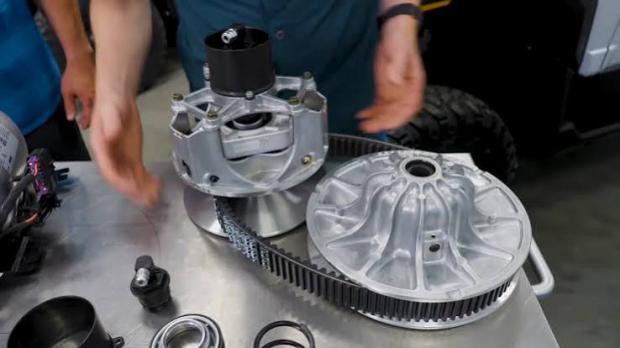
The transmission builds on the current mechanical CVT by adding pneumatics to soften noise and harshness when maximum rpm are not needed.
The system is redundant in that this isn't a brand new CVT design, it's an add-on to the existing mechanical design. An air compressor, a small air tank, and a pneumatic piston are added in order to control the CVT's output compression. If the pneumatic system fails for any reason, the CVT continues to operate mechanically, keeping the UTV trail-ready and operational.
Polaris' design for its mechanical CVT has been used in most of its vehicles for some time. It consists of a drive clutch and a driven clutch connected via a belt. The drive clutch, which is connected to the engine, is tower-shaped with springs and shift weights inside. At low RPM, it sits open. As engine speed rises, centrifugal force squeezes the drive clutch closed and pushes the belt farther outward. At the same time, the driven clutch, which is bell shaped, opens and lets the belt move inward. That shifts the CVT from a low ratio for more torque to a higher ratio for more speed.
With the added pneumatic system, Polaris engineers designed the addition to artificially compress the drive clutch with compressed air through a piston. Doing so reduces rpm, resulting in less engine noise, better fuel economy, and quieter CVT operation. The system is designed to have the pneumatics kick in during low-effort cruising or crawling when the vehicle does not require high torque. With a vehicle like the big Xpedition, for example, this results in a quiet cabin where a normal conversation level can be had when the pneumatics are engaged.
Control for when and how often the new air compression system does its thing is managed in any of three rocker switch settings. The simple switch includes Comfort, Standard, and Sport settings. With Comfort on, the system prioritizes lower rpm whenever possible. With Sport on, the system mostly ignores the pneumatics altogether, prioritizing speed and power. The Standard setting operates between the two extremes. The switch sits right next to the differential lock controls for off-road control.
The result of the pneumatic system on noise is significant. In Comfort mode, the noise levels in the unit at 35 mph (56 km/h) – which is considered "cruising speed" for the Xpedition UTV – drop by about 9 decibels, a 40% reduction versus the standard CVT's operation at that speed.
Adding an air compressor to the UTV has other benefits. The compressor is a very small, low-noise, high-output design that receives air through its own filtered nozzle. The connected tank holds just about enough air to inflate one of the unit's tires from nearly empty, or all four from off-road/air-down to fully aired up. This can be done through the Xpedition's new air nozzle built into the left-rear fender. A removable panel pops off (no tools required) to reveal the connector.