










Breaking News
 SpaceX Starship Flight 13 launch updates: Starship undergoing preparations to launch tomorrow
 MAJOR WAR UPDATE: Iran & US Both Sinking Tankers In Hormuz As War Spirals Out Of Control...
 Why Planned Parenthood Should Not Receive Federal Funds
 Ukraine blitzes another 19 Russian tankers overnight, with 136 vessels now hit in ten days...
Top Tech News
 Modular Reactors To Solve Data Center Hysteria?
 DeepSeek Developing In-House AI Chip In Bid To Cut Nvidia Reliance
 America just took three brand-new nuclear reactors critical in thirty days, a first for any...
 Your brain doesn't peak in your 20s after all: Study reveals your mind is at its sharpest betwee
 Compasses, not maps: China is building a different type of AI
 The Return of the Ekranoplan
 Farewell, atom-smashing Large Hadron Collider
 This is already starting.
 The Crosley IcyBall
 It's Not a Conspiracy Anymore: Med Beds Exist and Trump Knows It



US-China moon race could turn into a lunar land grab
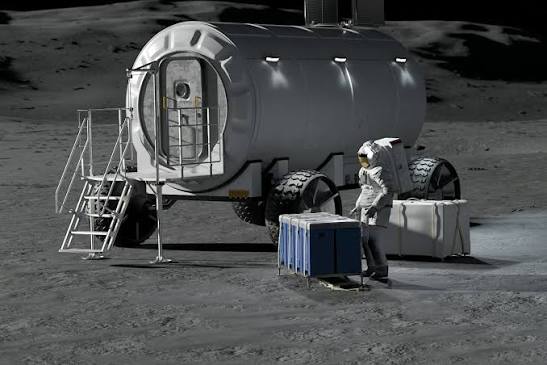
Sixty years ago, the United States and the Soviet Union were embroiled in a race to the moon, which the US won. The 21st-century lunar contest, with China stepping in for the Soviet Union, has many similarities but also key differences.
The Apollo astronauts planted the stars and stripes in lunar soil, bounced – and drove – around, set up experiments and collected scientifically valuable rock samples. Ultimately, however, there was no real plan to stay.
The new moon race is different: space agencies are targeting the south pole of the moon due to its deposits of water ice. This water can be used for life support on a lunar base. It can also be turned into rocket fuel, splitting it into the hydrogen and oxygen used by space vehicles, making it a valuable resource.
But ice deposits are not evenly distributed and suitable spots for establishing human outposts are finite. This could spark competition to bag the best spots. So will the US-China lunar contest turn into a land grab?
For anyone growing up in the 1980s and 90s, human space travel almost seemed to become "routine", but that era was still mainly the domain of the US and the Soviet Union (and then Russia). While the European Space Agency was growing, it focused largely on robotic scientific mission and commercial launches.
Now, 30 years later, the sector has grown massively, and space is no longer the sole domain of a few superpowers.
Around 20 nations are able to carry out space launches, mainly to send satellites into orbit. But there have also been privately funded robotic missions to the moon – albeit with significant support from government agencies.
Despite this globalization of space, only three countries are currently able to send humans into space using their own rockets: the US, Russia and China. This is largely a reflection of the fact that spaceflight gets much harder when people are involved, because they need continuous supplies of food, water, heat and air.
Space is an unforgiving environment, so there is absolutely no margin for error. There's limited scope for backup or rescue, and so everything needs to be tested and tested again.