










Breaking News
 US Army trials unmanned Hunter Wolf robot with gun, radar in combat drills
 EXCLUSIVE: "The Star Witness Against The Proud Boys' Trial Recanted His Testimony, Stating.
 Exclusive: Alex Jones Responds to Trump's Newest Vicious Attack On Himself, Tucker & Candace!
 Civil Society Needs the High Trust that Only Individuals Can Provide
Top Tech News
 Researchers Turn Car Battery Acid and Plastic Waste into Clean Hydrogen and New Plastic
 'Spin-flip' system pushes solar cell energy conversion efficiency past 100%
 A Startup Has Been Quietly Pitching Cloned Human Bodies to Transfer Your Brain Into
 DEYE 215kWh LiFePO4 + 125,000W Inverter + 200,000W MPPT = Run A Factory Offgrid!!
 China's Unitree Unveils Robot With "Human-Like Physique" That Can Outrun Most People
 This $200 Black Shaft Air Conditions Your Home For Free Forever -- Why Is It Banned in the U.S.?
 Engineers have developed a material capable of self-repairing more than 1,000 times,...
 They bypassed the eye entirely.
 The Most Dangerous Race on Earth Isn't Nuclear - It's Quantum.
 This Plasma Stove Cooks Hotter Than The Sun


Four Times the Ion Drive Thrust With 20+KW Nuclear Reactor for 2028 NASA Mars Mission
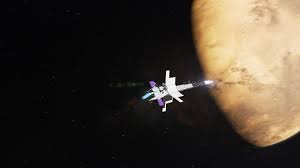
SR-1 Freedom will use 20-plus kilowatt fission reactor fueled by High-Assay Low-Enriched Uranium and Uranium Dioxide, encased in a Boron Carbide Radiation Shield. This will power a xenon ion drive. Previous nuclear spacecraft designs involved more powerful direct usage of nuclear to achieve propulsion. Those there nuclear thermal to achieve 2-4 times the temperature and thrust speed or nuclear electric direct drives.
The most powerful flown gridded xenon ion engine is NASA's NEXT (NASA Evolutionary Xenon Thruster) at 6.9 kW producing up to 237 mN of thrust (Isp ~4,170 s). It has flown on DART and is the current state-of-the-art operational gridded ion engine. SR-1 Freedom would be about three ties as powerful.
Higher-power examples like HiPEP reached the 25 kW class in brief ground tests but were even less mature than NEXIS.
If we include Hall-effect thrusters — which are also xenon plasma/ion engines and are often called ion thrusters in popular/NASA descriptions — the record is the X3 Hall thruster at 102 kW / 5.4 N in ground tests. AEPS, the 12–13 kW Hall thruster, is currently the most powerful flight-qualified xenon electric propulsion system.
SR-1 Freedom (Space Reactor-1 Freedom) and the 20 kW nuclear reactor
SR-1 Freedom is NASA's planned 2028 Mars demonstration mission (first nuclear-electric propulsion interplanetary spacecraft). It repurposes the already-built and tested Power and Propulsion Element (PPE) from the cancelled Lunar Gateway.
The PPE carries: 3 × AEPS Hall thrusters (~12–13 kW each)
4 × Busek 6 kW Hall thrusters
Originally solar-powered, it is now being paired with a new over 20 kW fission reactor (closed Brayton cycle, HALEU fuel) to provide constant electrical power to the thrusters.
Power comparison
SR-1 Freedom's propulsion system gets a steady ~20 kW (reactor-limited) — roughly 3× the power of a single NEXT engine and equal to or slightly higher than the highest previously tested gridded ion engine (NEXIS).
Unlike solar-powered ion systems (which lose power as you move away from the Sun), the nuclear reactor delivers full power anywhere in the solar system.
Thrust comparison (approximate, at full reactor power)
Hall thrusters like AEPS are more thrust-dense than gridded ion engines.
With ~20 kW available Expected total thrust ≈ 0.8–1.2 N (800–1,200 mN), depending on how many thrusters are run and at what throttle.
For reference: a single NEXT produces only 237 mN at 6.9 kW.