










Breaking News
 The System Being Built While the World Burns
 As Epstein's Clients Walk Free, an Innocent Man Rots in a Cage for Promoting Liberty
 Federal Appeals Court Allows Pentagon To Designate Anthropic As A Supply-Chain Risk
 Artemis II Astronauts Prepare For Re-Entry, Splashdown
Top Tech News
 Anthropic says its latest AI model is too powerful for public release and that it broke...
 The CIA used a futuristic new tool called "Ghost Murmur" to find and rescue...
 This Plant Replaces All Fertilizer FOREVER. Why Did the FDA Ban It?
 China Introduces Pistol-Like Coil-Gun Based On Electromagnetic-Launch Systems
 NEXT STOP: MARS IN JUST 30 DAYS?!
 Poland's researchers discovered a bacteria strain that destroys pancreatic cancer.
 Intel Partners with Tesla and SpaceX on Terafab
 Anthropic Number One AI in Ranking and Revenue - Making $30 Billion Per Year
 India's indigenous fast breeder reactor achieves critical stage: PM Modi
 Mexico Speeds Up Biometric ID Rollout


Artemis II Astronauts Prepare For Re-Entry, Splashdown
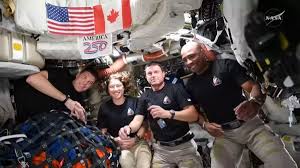
NASA's Reid Wiseman, Victor Glover, and Christina Koch, and Jeremy Hansen of the Canadian Space Agency, continue to fall back to Earth on a free return trajectory aboard their Orion spacecraft, Integrity, targeting a splashdown in the Pacific Ocean at about 8:05 p.m. ET on April 10.
Over the past eight days, those astronauts became the first people in more than 50 years to leave Earth's orbit and cross the proverbial channel of deep space to fly around the moon.
They ventured farther from Earth than any other human expedition in history. They saw areas and aspects of the lunar surface that no other humans had ever been able to see with their own eyes, and they became the first humans ever to observe a full solar eclipse from lunar space.
They captured striking images of their home planet, and shared a call with their colleagues onboard the International Space Station, marking the first time in spaceflight history that a crew in deep space communicated directly with a crew in low Earth orbit.
But now, it's almost time to come home.
On April 8, the crew started preparing their capsule for arrival, storing equipment and securing items for the upcoming comet-like ride through the Earth's atmosphere.
They started reinstalling their seats into the configuration for launch and reentry, and they tested their orthostatic intolerance garments.
Those special garments are worn underneath the astronaut's spacesuits to help "maintain blood pressure and circulation during the transition back to Earth's gravity," NASA explained.
"After extended time in microgravity, some astronauts experience orthostatic intolerance, a condition that can make it difficult to stand upright without dizziness or fainting. The garment applies lower?body compression to counteract this effect and support a safe return."
The crew was also supposed to demonstrate deployment of an emergency radiation shield inside the cabin, a procedure developed in case astronauts encounter a high dose of radiation beyond Earth orbit. But mission teams decided to forego the demonstration to prepare Integrity for reentry.
The spacecraft also executed short course correction burns on April 7 and April 8, and a third was scheduled for April 9. Also on April 8, the crew took manual control of their ship one last time, turning it around to point the tail end toward the sun.