










Breaking News
 Food Rationing Warnings in Australia + Cyberattack Alerts - Time to Grow!
 Iranian-Affiliated Cyber Actors Exploit Programmable Logic Controllers...
 Mysterious Bitcoin inventor Satoshi Nakamoto is 'unmasked' as British nerd who could...
 'Jihadists' slaughter more than 40 in Nigerian village raid: 'They killed everyone in si
Top Tech News
 China Introduces Pistol-Like Coil-Gun Based On Electromagnetic-Launch Systems
 NEXT STOP: MARS IN JUST 30 DAYS?!
 Poland's researchers discovered a bacteria strain that destroys pancreatic cancer.
 Intel Partners with Tesla and SpaceX on Terafab
 Anthropic Number One AI in Ranking and Revenue - Making $30 Billion Per Year
 India's indigenous fast breeder reactor achieves critical stage: PM Modi
 Mexico Speeds Up Biometric ID Rollout
 Homemade solar drone smashes endurance record with 5+ hours aloft
 This Home Flywheel Makes Storing Solar 90% Cheaper -- And It Works Forever!
 Physicists captured a crystal made only of electrons, forming a honeycomb pattern without atoms...



Trump declares Strait of Hormuz 'joint venture' with Iran as Tehran's tollbooth is set t
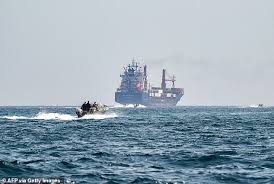
Donald Trump has called a US-Iran deal to reopen the Strait of Hormuz a 'joint venture' as Tehran prepares to charge ships up to $1 million per vessel to pass through the world's most critical oil artery.
Iran agreed to a two-week ceasefire and will reopen the waterway while a 10-point peace plan is negotiated by both sides, Trump announced Wednesday.
The exact terms remain unsettled, but ships must notify intermediary companies linked to the Islamic Revolutionary Guard Corps (IRGC) of their cargo, destination and owner - with tolls of at least $1 per barrel payable in Chinese yuan or cryptocurrency.
Trump welcomed the idea on Wednesday, telling ABC: 'We're thinking of doing it as a joint venture. It's a way of securing it - also securing it from lots of other people.
'It's a beautiful thing.'
The Strait, through which a fifth of the world's oil flows, has been dubbed the 'Tehran Tollbooth' by analysts and traders as IRGC patrol boats will only escort vessels once payment clears.
Some analysts believe the scheme could net Iran as much as $500 billion over five years.
Hamid Hosseini, a spokesperson for Iran's Oil, Gas and Petrochemical Products Exporters' Union, said that cargo checks were necessary to prevent the transport of weaponry.
'Iran needs to monitor what goes in and out of the strait to ensure these two weeks aren't used for transferring weapons,' Hosseini, whose industry association has close ties to the regime, told the FT.
'Everything can pass through, but the procedure will take time for each vessel, and Iran is not in a rush,' he added.
Hosseini's comments indicate that vessels must hug the northerly Iranian coast of the Strait - which will raise concerns for maritime insurers.
Tankers in the Persian Gulf on Wednesday received a radio alert warning that they would be targeted if they did not first gain transit approval from Iranian authorities.
'If any vessels try to transit without permission, [they] will be destroyed,' said the broadcast in English.
Western shipping giants were working frantically to establish details over whether the Strait was truly operational again.
Maersk, the world's second biggest shipping line, said it was 'working with urgency' to clarify the terms.