










Breaking News
 Iran War Hits Cyber, Food, Energy: Stryker Cyberattack, India Fertilizer Stoppage
 Now Its Time to PANIC
 Cork Stryker plants hit by suspected global Iranian-linked cyberattack
270 WSM Ballistics From Major Manufacturers
Top Tech News
 Human Brain Cells Merge With Silica To Play DOOM
 Will Yann LeCun Provide The Next Breakthrough In AI?
 Human Brain Cells Merge With Silica To Play DOOM
 Solar And Storage Could Reshape Rural Electricity Markets
 With World Seemingly At War, DARPA Finds Time To Unveil The X-76
 Renewable Water From Air.
 The world's first diesel plug-in hybrid pickup truck is here
 US advances nuclear revival with approval of Natrium Gen IV reactor
 Your Contractor Doesn't Want Me To Show You This!
 CEO of Blacklisted AI Company Anthropic, Dario Amodei Says His AI Models 'May Have Gained...



Choke Point: The Global Economic Consequences of The Persian Gulf Shutdown
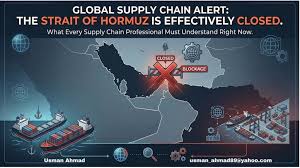
Its narrow exit — the Strait of Hormuz, just 33 kilometres wide at its narrowest point — acts as a valve through which flows an extraordinary share of the world's energy and agricultural inputs. A sustained closure of that valve by Iran will trigger an economic shock with few historical precedents.
Let's look at the three commodity categories most exposed to such a disruption: crude oil and refined petroleum products, liquefied natural gas (LNG), and urea, the nitrogen fertiliser upon which modern agriculture depends. Together, these three flows underpin not just energy markets but global food security, industrial production, and the fiscal stability of dozens of nations.
The Strait of Hormuz: A Single Point of Failure
Roughly 20–21 million barrels of oil pass through the Strait of Hormuz every day, representing approximately 20% of global petroleum liquids consumption and around 30% of seaborne crude trade. The Gulf states bordering this corridor — Saudi Arabia, the United Arab Emirates, Kuwait, Iraq, Iran, and Qatar — collectively hold the majority of the world's proven oil reserves and a dominant share of global LNG export capacity.
There is no adequate alternative. The East-West Pipeline across Saudi Arabia (Petroline) can carry around 5 million barrels per day, and the Habshan-Fujairah pipeline in the UAE adds limited bypass capacity. But these routes are insufficient to compensate for a full shutdown, and are themselves vulnerable to sabotage. For the first time in history the oil has stopped flowing.
Oil: The Immediate Shock
The abrupt closure of Persian Gulf oil exports will constitute the largest supply shock in the history of petroleum markets — larger in absolute terms than the 1973 Arab oil embargo or the Iranian Revolution of 1979, both of which removed far smaller volumes, if Iran maintains the blockade for a month or longer. The International Energy Agency estimates that OECD strategic reserves could theoretically cushion a disruption for several months, but the psychological and speculative impact on oil prices would be immediate and severe.
Analysts and historical precedent suggest that oil prices could spike to anywhere between $150 and $250 per barrel — or potentially higher if markets judged the disruption likely to be prolonged. At such prices, the consequences would radiate rapidly through the global economy:
Fuel costs and consumer prices. Petrol, diesel, aviation fuel, and heating oil prices have all surged. In major consuming economies — the United States, Europe, China, Japan, India — consumer price inflation will accelerate sharply with a prolonged disruption. Households will face dramatically higher energy bills and transport costs within weeks.
Industrial contraction. Energy-intensive manufacturing sectors — petrochemicals, cement, steel, aluminium, glass — will face crippling input cost increases. Many would reduce output or shut down. Supply chains across the global economy would seize as freight costs soared.