










Breaking News
 From Inflation to Hyperinflation: The Gathering Monetary Hurricane
 Deputy Attorney General Todd Blanche Fired Ed Martin as Chief of DOJ's Weaponization...
 Clintons Bend The Knee To Comer, Agree To Testify In House Epstein Inquiry
 White House Ignores Congress -Hands More Weapons To Israelis & Saudis
Top Tech News
 How underwater 3D printing could soon transform maritime construction
 Smart soldering iron packs a camera to show you what you're doing
 Look, no hands: Flying umbrella follows user through the rain
 Critical Linux Warning: 800,000 Devices Are EXPOSED
 'Brave New World': IVF Company's Eugenics Tool Lets Couples Pick 'Best' Baby, Di
 The smartphone just fired a warning shot at the camera industry.
 A revolutionary breakthrough in dental science is changing how we fight tooth decay
 Docan Energy "Panda": 32kWh for $2,530!
 Rugged phone with multi-day battery life doubles as a 1080p projector
 4 Sisters Invent Electric Tractor with Mom and Dad and it's Selling in 5 Countries



From Inflation to Hyperinflation: The Gathering Monetary Hurricane
"An increase in the amount of currency in circulation, resulting in a relatively sharp and sudden fall in its value and rise in prices: it may be caused by an increase in the volume of paper money issued or of gold mined, or a relative increase in expenditures as when the supply of goods fails to meet the demand."
However, Investopedia states:
"Inflation is an increase in the average price of goods and services over time."
A quick check will reveal that Investopedia is not alone in their current definition. The definition has moved away, in large part, from the previous definition of the root cause to now describing a symptom.
But are we splitting hairs here? Does it really matter whether people understand the root cause? Yes, it does, if we wish to understand that inflation sometimes serves a political purpose. As stated by John Maynard Keynes in Economic Consequences of the Peace,
"By a continuing process of inflation, government can confiscate, secretly and unobserved, an important part of the wealth of their citizens."
If we understand the 1983 Webster's definition of inflation, it becomes clear that Keynes does not merely imply that governments can benefit from an inflationary situation, should it occur. Governments can actually create the situation through the issuance of currency.
Keynes wrote his book in 1919 and, to say it was a hit with legislators would be an understatement. For the better part of one hundred years, his concepts have been at the centre of the economic policies of governments the world over. (US President Richard Nixon famously stated publicly, when he took the US dollar off the gold standard in 1971, "We're all Keynesians now.")
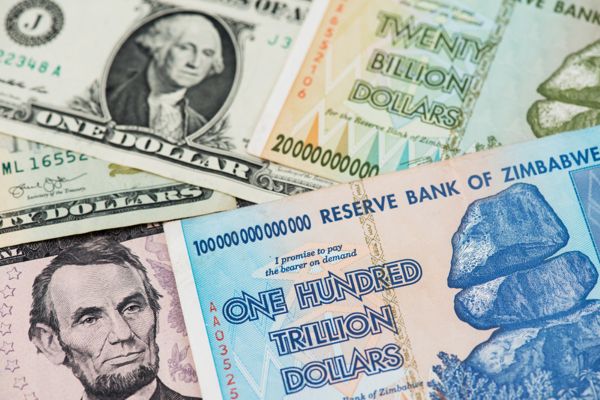
Hyperinflation Defined
So, the reader may take his pick as to which definition of inflation sits best with him, but, fortunately, there is less confusion over the definition of hyperinflation. Hyperinflation is typically defined as:
Ruinously high increase (50 percent or more per month) in prices due to the near total collapse of a country's monetary system, rendering its currency almost worthless as a medium of exchange.
Not much room for confusion there. Armed with a definition of this condition, we may examine the likelihood of being faced with hyperinflation in the near to not-too-distant future. Certainly, readers of this publication will be aware of the extreme monetary condition most First World countries are presently facing as a result of excessive debt, resulting in considerable inflation (by the1983 definition).