










Breaking News
 We Are Great
 Hustled Through Life
 Why the Federalists Hated the Bill of Rights
 TRUMP STRIKES BACK!!!
Top Tech News
 The smartphone just fired a warning shot at the camera industry.
 A revolutionary breakthrough in dental science is changing how we fight tooth decay
 Docan Energy "Panda": 32kWh for $2,530!
 Rugged phone with multi-day battery life doubles as a 1080p projector
 4 Sisters Invent Electric Tractor with Mom and Dad and it's Selling in 5 Countries
 Lab–grown LIFE takes a major step forward – as scientists use AI to create a virus never seen be
 New Electric 'Donut Motor' Makes 856 HP but Weighs Just 88 Pounds
 Donut Lab Says It Cracked Solid-State Batteries. Experts Have Questions.
 Researchers who discovered the master switch that prevents the human immune system...
 The day of the tactical laser weapon arrives


Births Plummet In China As Population Growth Stalls
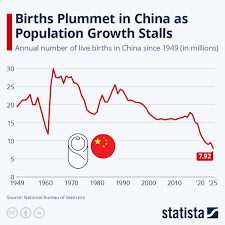
This marked a 17 percent decline from one year before, when it was 9.5 million.
As Statista's Anna Fleck reports, according to the National Statistics Bureau of China (NBS), the country's birth rate fell to 5.63 per 1,000 people in 2025.
This is the lowest level since 1949, when the Communist Party took power.
Meanwhile, China's death rate rose to 8.04 per 1,000 people.
This resulted in last year being the fourth consecutive year for the country's population to fall, reaching 1.4 billion.
Beijing has been trying to encourage its population to marry and have children.
The country's fertility rate stood at 1.3 children per woman in 2020 and has been below the 2.1 threshold necessary for a stable population since the 1990s.
Despite the early warning signs, China only scrapped its long-standing one-child policy in 2016, as fear of overpopulation gave way to fear of aging societies.
The country has introduced other incentives since, including offering parents 3,600 yuan ($500) for every child under three years old, as well as a new tax on contraceptives introduced on January 1.
The latter has been criticized over risks of unwanted pregnancies and HIV rates.
Experts attribute the falling fertility rate to China's economic and social development. Countries tend to experience lower birth rates in line with economic development as increased education access and concentration on careers become new priorities for the population.
That is certainly the case elsewhere in Asia, particularly in Japan and South Korea where birth rates have dropped significantly. The situation is especially concerning in South Korea where there were more deaths than births last year.