










Breaking News
 Is The Government Coming For Our Seeds?
 Looming ice storm could be among worst on record
 The walls are actually closing in on Ilhan Omar and her husband…
 Tesla and XAI's Digital Agent Strategy
Top Tech News
 The day of the tactical laser weapon arrives
 'ELITE': The Palantir App ICE Uses to Find Neighborhoods to Raid
 Solar Just Took a Huge Leap Forward!- CallSun 215 Anti Shade Panel
 XAI Grok 4.20 and OpenAI GPT 5.2 Are Solving Significant Previously Unsolved Math Proofs
 Watch: World's fastest drone hits 408 mph to reclaim speed record
 Ukrainian robot soldier holds off Russian forces by itself in six-week battle
 NASA announces strongest evidence yet for ancient life on Mars
 Caltech has successfully demonstrated wireless energy transfer...
 The TZLA Plasma Files: The Secret Health Sovereignty Tech That Uncle Trump And The CIA Tried To Bury
 Nano Nuclear Enters The Asian Market



Das: Trump's Spat With The Fed Is Not About Central Bank Independence
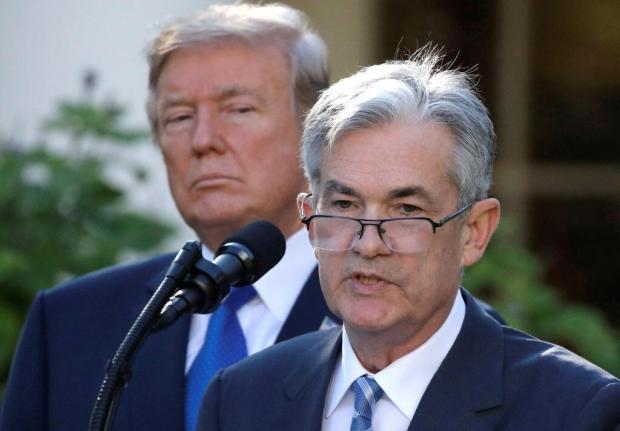
Central banks function as the government's banker, issue currency, maintain the payment system and manage the nation's currency reserves. They safeguard financial stability acting as a lender of last resort to banks although separate bodies sometimes regulate the financial system. The contentious part of their mandate is controlling money supply and setting interest rates.
Central bank independence is recent. In 1990, New Zealand legislated inflation targeting which was adopted by other nations. The concept was that an independent institution would determine monetary policy and maintain price stability minimising opportunities for politicians to use interest rates to boost economic activity especially around elections. The context was the high inflation era of the 1970s and 1980s. It was convenient to transfer painful choices to central bankers allowing governments to blame others or claim credit depending on outcomes.
The case for independence is unclear. The objectives, such as relative price stability, growth, and employment, are frequently contradictory. It is unclear which of multiple measures of price levels is to be prioritised. The 2 to 3 percent inflation objective is arbitrary. Empirical studies suggest that fear of deflation may be unwarranted. There are differences on what constitutes full employment. Data, rarely timely, has methodological problems. The representativeness of items used to measure inflation is contested. Unpaid work, zero-hour agreements and contracting complicates labour statistics. Resource scarcity or sustainability are ignored.
Central banks have limited tools – interest rates, regulating money supply through open market operations, quantitative easing (buying government debt) and forward guidance (open mouth operations or jawboning). Budgets, the currency, international capital flows, and geo-politics (sanctions, trade restrictions) are outside its control.
The underlying economic models focus on NAIRU (non-accelerating inflation rate of unemployment) or the Phillips Curve, a simplistic trade-off between unemployment and inflation. In practice, these relationships are unreliable. Cause and effect are difficult to differentiate. There is no agreement on a neutral (not contractionary or expansionary) interest rate. Central bankers constantly validate Laurence J. Peter's judgement: "an economist is an expert who will know tomorrow why the things he predicted yesterday didn't happen today."
The problems are compounded by training and backgrounds which lend themselves to groupthink. Central bankers are economists, usually trained at the same universities, who spend their working life around the institution, government or academe and limited commercial experience. Central banks are run by economists providing employment for their tribe. Independent members rarely second guess staff recommendations, even if they have the expertise and information.
Originally reticent, central banks, following the lead of former Fed Chairperson Alan 'Maestro' Greenspan, have embraced celebrity. Inscrutable invisibility has given way to volubility, X handles, and Delphic oratory. They play to financial markets with an excessive focus on asset prices which do not uniformly benefit all citizens. Politicians, never happy to share the limelight, increasingly resent the power and public profile of these unelected technocrats. They begrudge having to seek approbation for their policies. US Presidents found themselves forced to kowtow to the all-powerful Greenspan. They increasingly are wary of the threat to their position and re-election that central banks may pose.