










Breaking News
 "You Must Prepare Now" - Doug Casey
 Will the BRICS 'UNIT' really challenge the dollar?
 The U.S. Just Launched a Secret Dollar Empire (And Nobody Noticed)
 ICE Uses a Growing Web of AI Services to Power Its Immigration Enforcement and Surveillance
Top Tech News
 EngineAI T800: Born to Disrupt! #EngineAI #robotics #newtechnology #newproduct
 This Silicon Anode Breakthrough Could Mark A Turning Point For EV Batteries [Update]
 Travel gadget promises to dry and iron your clothes – totally hands-free
 Perfect Aircrete, Kitchen Ingredients.
 Futuristic pixel-raising display lets you feel what's onscreen
 Cutting-Edge Facility Generates Pure Water and Hydrogen Fuel from Seawater for Mere Pennies
 This tiny dev board is packed with features for ambitious makers
 Scientists Discover Gel to Regrow Tooth Enamel
 Vitamin C and Dandelion Root Killing Cancer Cells -- as Former CDC Director Calls for COVID-19...
 Galactic Brain: US firm plans space-based data centers, power grid to challenge China



Trump's Christmas Day strikes on Nigeria beg question: Why Sokoto?
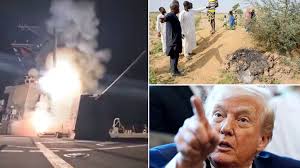
For the first time since President Trump publicly excoriated Nigeria's government for allegedly condoning a Christian genocide, Washington made good on its threat of military action on Christmas Day when U.S. forces conducted airstrikes against two alleged major positions of the Islamic State (IS-Sahel) in northwestern Sokoto state.
According to several sources familiar with the operation, the airstrike involved at least 16 GPS-guided munitions launched from the Navy destroyer, USS Paul Ignatius, stationed in the Gulf of Guinea. Debris from unexpended munition consistent with Tomahawk cruise missile components have been recovered in the village of Jabo, Sokoto state, as well nearly 600 miles away in Offa in Kwara state.
No civilian casualties were reported in both areas, although there were damages to buildings in Offa.
It is the first direct U.S. airstrike on Nigeria's soil — a West African oil-producing giant that Washington has often considered a crucial ally in the turbulent Sahel region. It is also the sixth country, following closely behind Iran, Iraq, Somalia, Syria and Yemen, where Trump has authorized airstrikes this year alone.
The U.S airstrike came a day after a bomb ripped through a mosque in Maiduguri in northeastern Nigeria, leaving at least five people dead and dozens injured. In a post on social media shortly after the airstrike, Trump identified the target as "ISIS Terrorist scum, who have been targeting and viciously killing, primarily, innocent Christians, at levels not seen for many years, and even Centuries!" He concluded by wishing everyone Merry Christmas "including the dead Terrorists." The U.S. Africa Command (Africom) also said that "multiple Isis terrorists were killed" in strikes on camps in Sokoto.
But days after, there is still no official confirmation by the Nigerian government that any terrorists were killed. Many Nigerians are also asking: Why Sokoto? "The airstrike raises more questions than it resolves", says Stephen Adewale, a Professor of History at the Obafemi Awolowo University (OAU) in Nigeria.
A predominantly Muslim state, Sokoto is far removed from the Middle Belt where Christian communities have suffered the most sustained and large-scale violence in recent years in complex conflicts involving armed groups, criminal gangs, and communal tensions. The state is also far removed from the epicenter of the jihadist insurgency in Borno State in the northeast and the Lake Chad Basin area where the more prominent terrorist groups, Boko Haram (JAS) and Islamic State of West Africa Province (ISWAP) have built a base. Except for a network of notorious bandit groups that abduct civilians for ransom, Sokoto, whose population in any case is overwhelmingly Muslim, has not experienced the same scale of jihadist violence as other states in the region.