










Breaking News
 Smart Dust
 Floating Energy Assets Explained
 What if Iran's next move against Washington is not a missile launch, but a convoy of oil tankers
 Artificial Intelligence Could Transform Bank Runs From Hours-Long Crises...
Top Tech News
 Dubai Just Finished the World's First Permanent Air Taxi Route: Airport to the Marina in Under 1
 Doroni Aerospace Raises More than $60m for H1?X Development
 After 13 Years Battling Cancer, a 61-Year-Old Brazilian Man Achieved Complete Remission...
 Extraterrestrial habitats may rise via Legos of laser-fused moon dust
 Battery-only 19-seater puts China in the electric airliner race
 Dream Chaser space plane gets landing approval for debut mission in 2027
 SpaceX Just Caught Starship on Its FIRST Attempt!
 Solid-State Cells Can Make The U.S. Competitive In Batteries Again: CEO
 Jetson ONE personal eVTOL pod is about to go full sky patrol
 America's INSANE BREAKTHROUGH Could Replace Septic Tanks Forever



High-yield Solar Greenhouse harvests food & energy (timelapse)
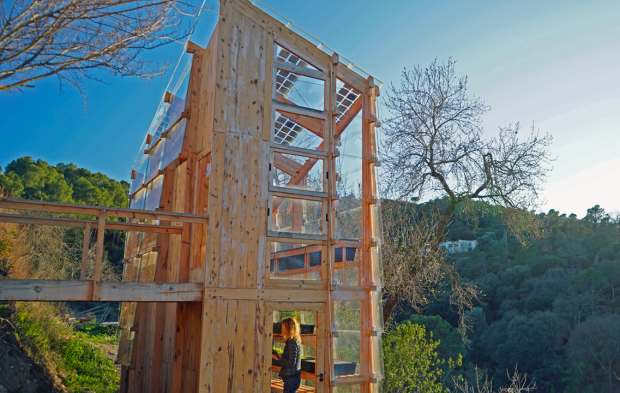
The unit is providing food for the lab's kitchen, as well as for a local restaurant, but it's also a prototype for urban food self-sufficiency, and a larger model is currently being built on the roof of a new Barcelona skyscraper.
The wood for the prototype was all harvested, milled, dried, processed and pressed into CLT (cross-laminated timber) boards entirely on-site. All the pieces were designed to snap together, every joint pre-planned on computer and all hinges were custom CNC-printed, as Valldaura Labs' co-director Daniel Ibáñez explains.
The planting method is all hydroponics, using sawdust waste from the lab as the substrate. The greenhouse is irrigated with rainwater which is recaptured after going through the hydroponic system, to be reused on the gardens.
The students and teachers at IAAC (Institute of Advanced Architecture of Catalonia) hope that their two-story greenhouse can serve as a prototype for urban rooftop food production. Currently, a 100-square-meter version is being built atop a new wooden skyscraper that will be Catalonia's tallest CLT building.