










Breaking News
 Swap Lines: The Federal Reserve Extends Its Tightrope
 The Transgender Mirage Is Cracking
 The Collapse of the Saudi-American Alliance?
 BREAKING: EPA eliminates rule that limits 'greenhouse gas' emissions from power plants
Top Tech News
 Quantum computing may soon become part of the microscope itself.
 Volkswagen Just Unveiled The Most Efficient EV Ever Tested
 NASA Super Light Solar Sail Project Will Be 12-40 Times Lighter and Faster
 Space Telescope Interferometer to Image Exoplanet Continents
 Twenty-five years of "temporary": how 9/11 built a surveillance state Americans never vote
 I'll Never Buy Another WALMART Battery!
 Shoei GT-Air 3 Smart helmet drops with built-in AR for $1,500
 AI Whistleblower Tells Tucker How AI Could Kill All Humans by 2040
 You Hate Flock? Well There's More...
 Will Spiking Diesel Prices Drive Autonomous Trucking?



Watch NASA's DART spacecraft hit 'bullseye' by smashing into an asteroid
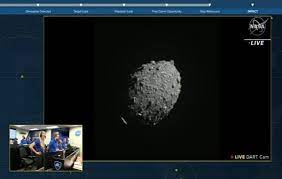
NASA's asteroid smashing spacecraft completed its spectacular doomed attack on a distant asteroid last night, and we already have three awe-inspiring videos of the event.
The Double Asteroid Redirection Test (DART) spacecraft collided with the 7 million mile (11 million kilometer) distant asteroid Dimorphos at 7:14 p.m. ET on Monday (Sept. 26) in humanity's first attempt to alter an asteroid's trajectory.
DART recorded and beamed back its final moments with its onboard Didymos Reconnaissance and Asteroid Camera for Optical Navigation (DRACO), which was also responsible for automatically navigating the spacecraft onto its collision course. As DART came ever closer to the space rock, its camera feed showed the asteroid's landscape bloom from a single pale gray pixel to a rough and craggy terrain strewn with sharp, shadowy rocks.
"We saw that we were going to impact. This asteroid was coming into the field of view for the first time. We really had no idea what to expect," Elena Adams, a mission systems and the spacecraft systems engineer for the DART mission, said at a news conference (opens in new tab) after the event. "All of us were kind of holding our breaths."