










Breaking News
 'UNFAIR': Mamdani's city-run grocer plan SLAPPED with lawsuit
 Trump Says If Iran Had a Nuclear Weapon, He Would Have Politely Called the Supreme Leader...
 Tucker Carlson: We are on the brink of a world war that ends with the use of nuclear weapons
 Who is trying to destroy the United States and the world?
Top Tech News
 NASA Super Light Solar Sail Project Will Be 12-40 Times Lighter and Faster
 Space Telescope Interferometer to Image Exoplanet Continents
 Twenty-five years of "temporary": how 9/11 built a surveillance state Americans never vote
 I'll Never Buy Another WALMART Battery!
 Shoei GT-Air 3 Smart helmet drops with built-in AR for $1,500
 Freezable titanium plate keeps your cooler chilled way longer than ice packs
 Review: Affordable thermal device is made for discovering life outdoors
 AI Whistleblower Tells Tucker How AI Could Kill All Humans by 2040
 You Hate Flock? Well There's More...
 Will Spiking Diesel Prices Drive Autonomous Trucking?



Could hydrogen airships return as fast, cheap, green cargo transports?
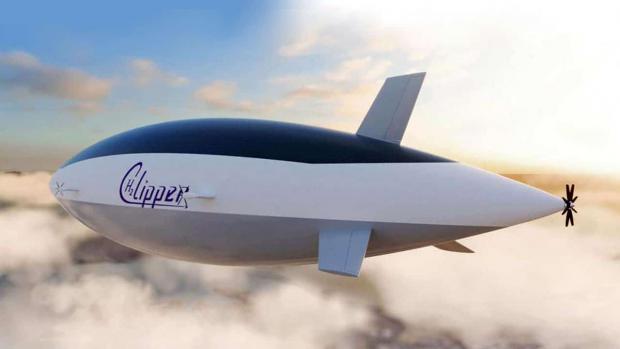
The H2 Clipper would carry payloads up to and beyond 340,000 lb (150,000 kg), says the company, and would offer up to 265,000 cubic feet (7,530 cubic metres) of cargo space. It wouldn't travel as fast as a plane, cruising at about 175 mph (282 km/h), but it would move boxes some 7-10 times faster than a boat (China to the US in 36 hours, for example) and with zero emissions.
Its lift gas would be hydrogen – providing some 8 percent more lift per volume than helium at something around 1/67th the price. Its propulsion would be fully electric, running on liquid hydrogen put through a fuel cell. H2 Clipper says it'd operate efficiently for missions ranging from under 500 miles (804 km) to "well over 6,000 miles (9,656 km)." That would link any two points on the globe with a single fuel top-up. In the current renders, the company shows the top of this huge aircraft covered in photovoltaic cells, which could theoretically enable it to generate its own hydrogen, if it were to carry a water source and an electrolyzer.
With the right provisions put in place, it could take goods right from a factory to a distribution center without needing additional ground transport stages to and from airports, thanks to its vertical takeoff and landing capabilities.
H2 Clipper says the economics will be attractive as well, estimating costs between US$0.177 to $0.247 per ton-mile for distances between 1,000-6000 miles. It says this is a quarter of the price of today's air transport. Certainly, it'll still be more expensive than sending things on a container ship, but it does potentially cut out additional logistics challenges at either end – and the shipping sector's emissions issues could well see it slapped with carbon taxes as the race to zero carbon by 2050 develops globally.
On the surface, it all looks to work pretty neatly. Of course, there's a large elephant in the room here, or at least a huge manatee: hydrogen, along with any other flammable substance, is currently prohibited as a lift gas in the United States and Europe, due to some high-profile dirigible disasters in the early 1900s, burned into the public consciousness by newsreels of the Hindenburg conflagration in 1937 that killed 35 of the 97 people on board.