










Breaking News
 This is the future we shall bring into being
 Elon Musk's Vision For The Future Looks Like A Movie
 Phosphorus Munitions Fired by Israel Burn Groves, Orchards in Southern Lebanon
 Iran's IRGC Warns It Will Expand 'Geography of the War' If the US Attacks Again
Top Tech News
 BEYOND THE MOON: NASA plans a nuclear-powered fleet to push DEEPER into space
 Big Oil Backs Mazama's $135 Million Bet On Superhot Geothermal
 Quantum compass takes flight on Northrop's Lumberjack drone
 Terrifying AI Behavior Even Its Creators Couldn't Explain
 WW3 Near-Miss? AI Hallucinated Nuclear Weapons Components Aboard Chinese Vessel Bound For Iran
 Stripe Is Building the Toll Road for the Machine Economy
 Toyota Dakar hopeful swaps twin-turbo V6 for hydrogen fuel cells
 4-min turbo-inflatable cubic camp castle is now available in the USA
 Researchers Used Claude To Hack OpenAI Employee Accounts
 Chinese Scientists Develop New Oil Refining Method That Cuts Energy Use by 90%



Energy Observer: On board the world's first hydrogen-powered boat
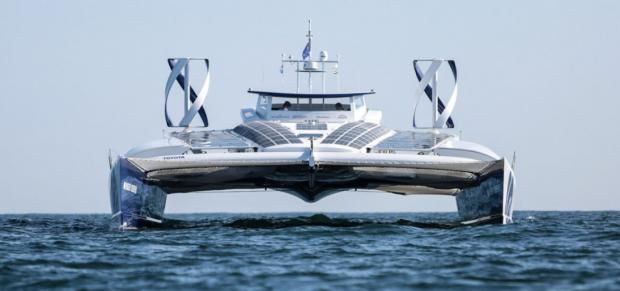
Moored in the San Francisco Bay, the Energy Observer is nearly impossible to ignore. A nonstop flow of tourists walking the city's historic Embarcadero stop for selfies with the ship (even though most don't know what it is). I watch as I wait to board.
My tour of the 100-foot catamaran is a result of good or bad luck, depending on your point of view. The Energy Observer and its 10-person crew are on an unscheduled stop here due to weather, on their way from Southern California to Hawaii. The ship has been at sea since 2017, out to prove its technological tools in the harshest possible conditions.
"If they can survive here, they'll work really well on land." says Katie Nicolet, the ship's scientist. "The ultimate goal is to showcase that we can use renewable energies to navigate and go around the world" without any type of emissions.
Without a doubt the most striking feature of the catamaran are its 202 square meters of solar panels, covering the majority of its exposed surface. Most of the time they feed the batteries that power everything on board, from the engines to the kitchen appliances. "But on a day like today, when we drop anchor, we don't have engines (running); we're producing too much energy. So instead of wasting it, we're going to turn the excess energy into hydrogen." says Nicolet.
Using reverse osmosis, pumped-in seawater is converted to pure water that's then electrolyzed by the onboard batteries. The electrolyzation separates the water molecules into pure oxygen and hydrogen. The hydrogen is stored in eight tanks on the ship's wings. Nicolet says the tanks can store enough hydrogen to power the ship for six days. When the batteries run low and there's not enough sun, the hydrogen is used to create electricity using the same fuel cell found in the Toyota Mirai sedan.
The chemical process the fuel cell uses to create electricity also produces water and heat. The water is collected in tanks, and the heat is used to warm the cabin and for hot water.