










Breaking News
 The Tesla Semi Just Got A Massive Boost From The Biggest U.S. Electric Truck Order Ever
 California Declares State Of Emergency Ahead Of Strong El Niño
 'Pausing' Intensifies: OpenAI Unleashes Latest Model Minutes After Dario Dumps Magnum Opus
 Trump Calls For Diesel Export Ban After 3-Hour 'Very Productive' Iran Talks
Top Tech News
 BEYOND THE MOON: NASA plans a nuclear-powered fleet to push DEEPER into space
 Big Oil Backs Mazama's $135 Million Bet On Superhot Geothermal
 Quantum compass takes flight on Northrop's Lumberjack drone
 Terrifying AI Behavior Even Its Creators Couldn't Explain
 WW3 Near-Miss? AI Hallucinated Nuclear Weapons Components Aboard Chinese Vessel Bound For Iran
 Stripe Is Building the Toll Road for the Machine Economy
 Toyota Dakar hopeful swaps twin-turbo V6 for hydrogen fuel cells
 4-min turbo-inflatable cubic camp castle is now available in the USA
 Researchers Used Claude To Hack OpenAI Employee Accounts
 Chinese Scientists Develop New Oil Refining Method That Cuts Energy Use by 90%



Watch a Robot Dog Learn How to Deftly Fend Off a Human
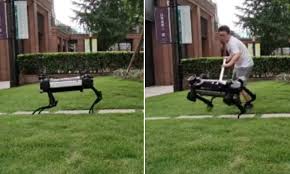
STUDY HARD ENOUGH, kids, and maybe one day you'll grow up to be a professional robot fighter. A few years ago, Boston Dynamics set the standard for the field by having people wielding hockey sticks try to keep Spot the quadrupedal robot from opening a door. Previously, in 2015, the far-out federal research agency Darpa hosted a challenge in which it forced clumsy humanoid robots to embarrass themselves on an obstacle course way outside the machines' league. (I once asked you, dear readers, to stop laughing at them, but have since changed my mind.) And now, behold: The makers of the Jueying robot dog have taught it a fascinating way to fend off a human antagonizer who kicks it over or pushes it with a stick.
A team of researchers from China's Zhejiang University—where the Jueying's hardware was also developed—and the University of Edinburgh didn't teach the Jueying how to recover after an assault, so much as they let the robot figure it out. It's a dramatic departure from how a hardware developer like Boston Dynamics goes about teaching a robot how to move, using decades of human experience to hard code, line by line, the way a robot is supposed to react to stimuli like, um, a person's foot.