










Breaking News
 This is the future we shall bring into being
 Elon Musk's Vision For The Future Looks Like A Movie
 Phosphorus Munitions Fired by Israel Burn Groves, Orchards in Southern Lebanon
 Iran's IRGC Warns It Will Expand 'Geography of the War' If the US Attacks Again
Top Tech News
 BEYOND THE MOON: NASA plans a nuclear-powered fleet to push DEEPER into space
 Big Oil Backs Mazama's $135 Million Bet On Superhot Geothermal
 Quantum compass takes flight on Northrop's Lumberjack drone
 Terrifying AI Behavior Even Its Creators Couldn't Explain
 WW3 Near-Miss? AI Hallucinated Nuclear Weapons Components Aboard Chinese Vessel Bound For Iran
 Stripe Is Building the Toll Road for the Machine Economy
 Toyota Dakar hopeful swaps twin-turbo V6 for hydrogen fuel cells
 4-min turbo-inflatable cubic camp castle is now available in the USA
 Researchers Used Claude To Hack OpenAI Employee Accounts
 Chinese Scientists Develop New Oil Refining Method That Cuts Energy Use by 90%



When It Comes to Generators, Bigger Is NOT Always Better
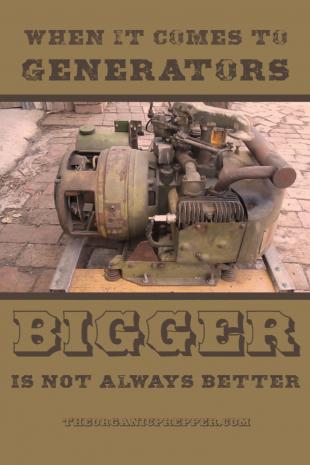
Everyone wants a big sexy generator that thunders to life 10 seconds after the lights go out. Suddenly the lights are back on, and life continues as it always has, even if the world is ending around them.
But is that behemoth generator the best option?
Generators are hot, smelly, cantankerous, and expensive, not to mention dangerous.
So what setup is best? According to your needs and circumstances, that will vary. But there are principles I will share with you here that I hope you find valuable.
There are some instances in which a generator is the best option. For example, you'd need one to run refrigerators and other appliances with sizeable electric motors. There are better options for cooking, heating, and lighting. And these options are far cheaper and more efficient than a mammoth generator. (And some people plan on a completely low-tech blackout with no power options at all.)
If you are looking to "go green", solar generators are good options.
When shopping for generators, only look at full sine wave models.
Anything else is asking for trouble. Start by looking on the internet at the specs for anything you want to buy. You will see the full load capacity and the fuel usage at full load. Multiply that by the number of hours and days you want to run it. Warning: the cost will make your head and visa card explode.
Look at the specs label of all the things you want to run: refrigerators, lights, television, routers, etc. Add the watts all together, divide by 1000, multiply by three. This equation will give you the kVA you need. On average, you're looking at a liter, per hour, per kVA.
You are better off with three small generators.
One generator for lighting and 2 generators for power is effective and efficient.
By only running the generators when it is necessary, running costs will be reduced. Small generators are sufficient at night for lights and tv. A large generator used 2 hours, three times a day for the refrigerator is adequate. Using this method will reduce your fuel consumption. And with the various generators, if you should have an equipment failure, you will have some redundancy.