










Breaking News
 This is the future we shall bring into being
 Elon Musk's Vision For The Future Looks Like A Movie
 Phosphorus Munitions Fired by Israel Burn Groves, Orchards in Southern Lebanon
 Iran's IRGC Warns It Will Expand 'Geography of the War' If the US Attacks Again
Top Tech News
 BEYOND THE MOON: NASA plans a nuclear-powered fleet to push DEEPER into space
 Big Oil Backs Mazama's $135 Million Bet On Superhot Geothermal
 Quantum compass takes flight on Northrop's Lumberjack drone
 Terrifying AI Behavior Even Its Creators Couldn't Explain
 WW3 Near-Miss? AI Hallucinated Nuclear Weapons Components Aboard Chinese Vessel Bound For Iran
 Stripe Is Building the Toll Road for the Machine Economy
 Toyota Dakar hopeful swaps twin-turbo V6 for hydrogen fuel cells
 4-min turbo-inflatable cubic camp castle is now available in the USA
 Researchers Used Claude To Hack OpenAI Employee Accounts
 Chinese Scientists Develop New Oil Refining Method That Cuts Energy Use by 90%



Superlight Micro-Engine That Weighs Just 22lbs and Is the Size Of A BACKPACK ...
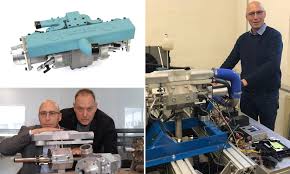
A hyper-efficient and super-light one-piston engine smaller than a backpack could render modern hybrids obsolete.
Shaul Yaakoby, 53, is the engineer from Tel Aviv, Israel, that developed the engine and claims it is capable of churning out enough horsepower to run a small hatchback for 750 miles (1,200 km) without refuelling.
The engine, manufactured by firm Aquarius Engine, is made of a only a dozen moving components.
MailOnline has obtained data from the firm which reveals the car engine to be 10 per cent more efficient than the average vehicle.
It is now undergoing field tests and the company expects its generator it to be commercially available by the end of 2020 and in cars by 2022.
Mr Yaakoby said its simplicity enables the lightweight design to be so efficient.
'What makes the Aquarius Engine so revolutionary is its simple design, we took the traditional combustion engine that hasn't really been changed in 150-years and we stripped it down to the bare necessities,' he said.
'This means a 10kg [22lbs] engine made up of 20 parts that is more efficient than a 200kg [220lbs] engine made of 200 parts.
'For over a century cars have been carrying around a ton of dead weight that has costed us power and efficiency.