










Breaking News
 Who Will Find What the Finders Hide? Addendum
 Seven Days in the Dark: How I Watched My Neighbors Turn Into Thieves...
 Oracle Invokes Force Majeure on Project Jupiter AI Data Center
 Something to Know About Saaaaaaafety
Top Tech News
 Tesla Model 3 killer charges from 10 to 97% in just 9 minutes
 World-first unpowered DNA computer sets speed record
 I Power 5 Buildings Off-Grid. Here's How
 The US government is pushing hard to get a working nuclear fission reactor into space by late 2028
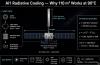 SpaceX Starmind AI in Space Radiator
 China Will Dominate Global Nuclear Energy Through 2035, Analyst Says
 These Absolutely Wild-Looking EVs Are Saudi Arabia's First Homegrown Cars
 BEYOND THE MOON: NASA plans a nuclear-powered fleet to push DEEPER into space
 Big Oil Backs Mazama's $135 Million Bet On Superhot Geothermal
 Quantum compass takes flight on Northrop's Lumberjack drone


Two Different Quantum Dot Qubits Combined to Overcome Limitations
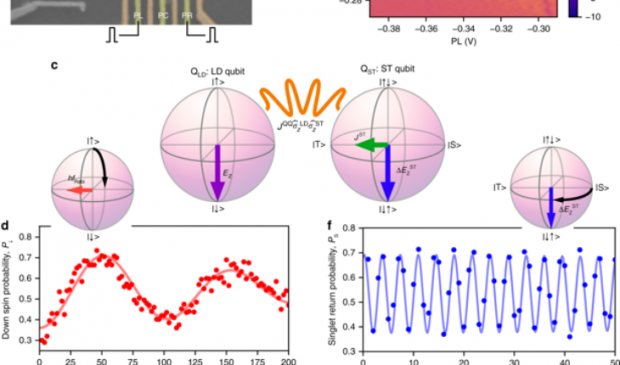
They combined single-spin qubit called a Loss-DiVincenzo qubit and a singlet-triplet qubit.
The Loss-DiVincenzo qubit has very high control fidelity—meaning that it is in a clear state, making it ideal for calculations, and has a long decoherence time. It will stay in a given state for a relatively long time before losing its signal to the environment. Unfortunately, the downside to these qubits is that they cannot be quickly initialized into a state or read out.
The singlet-triplet qubit is quickly initialized and read out, but it quickly becomes decoherent. They combined the two types with a type of quantum gate known as a controlled phase gate, which allowed spin states to be entangled between the qubits in a time fast enough to maintain the coherence, allowing the state of the single-spin qubit to be read out by the fast singlet-triplet qubit measurement.