










Breaking News
 "Begin Preparing Yourself..." - Jeffrey Sachs
 The 5-Year Treasury Just Broke 5%... The Whole Curve Is Next
 ICE Denounced for Enacting 'Official Government Policy of Disappearing People'
 Google Just Told Canadian Adults: Give Us Your ID and a Selfie Or Else…And It's Starting Now!!
Top Tech News
 Tesla Model 3 killer charges from 10 to 97% in just 9 minutes
 World-first unpowered DNA computer sets speed record
 I Power 5 Buildings Off-Grid. Here's How
 The US government is pushing hard to get a working nuclear fission reactor into space by late 2028
 SpaceX Starmind AI in Space Radiator
 China Will Dominate Global Nuclear Energy Through 2035, Analyst Says
 These Absolutely Wild-Looking EVs Are Saudi Arabia's First Homegrown Cars
 BEYOND THE MOON: NASA plans a nuclear-powered fleet to push DEEPER into space
 Big Oil Backs Mazama's $135 Million Bet On Superhot Geothermal
 Quantum compass takes flight on Northrop's Lumberjack drone


Construction of integrated gene logic-chip
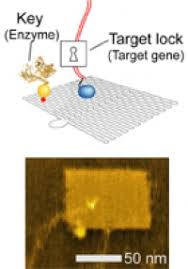
The key steps are sensing the environment, computing information and outputting products. To achieve such functions, the laborious, combinational networking of enzymes and substrate-genes is required, and to resolve problems, sophisticated design automation tools have been introduced. However, the complexity of genetic circuits remains low because it is difficult to completely avoid crosstalk between the circuits. Here, we have made an orthogonal self-contained device by integrating an actuator and sensors onto a DNA origami-based nanochip that contains an enzyme, T7 RNA polymerase (RNAP) and multiple target-gene substrates. This gene nanochip orthogonally transcribes its own genes, and the nano-layout ability of DNA origami allows us to rationally design gene expression levels by controlling the intermolecular distances between the enzyme and the target genes. We further integrated reprogrammable logic gates so that the nanochip responds to water-in-oil droplets and computes their small RNA (miRNA) profiles, which demonstrates that the nanochip can function as a gene logic-chip. Our approach to component integration on a nanochip may provide a basis for large-scale, integrated genetic circuits.