










Breaking News
 "Begin Preparing Yourself..." - Jeffrey Sachs
 The 5-Year Treasury Just Broke 5%... The Whole Curve Is Next
 ICE Denounced for Enacting 'Official Government Policy of Disappearing People'
 Google Just Told Canadian Adults: Give Us Your ID and a Selfie Or Else…And It's Starting Now!!
Top Tech News
 Tesla Model 3 killer charges from 10 to 97% in just 9 minutes
 World-first unpowered DNA computer sets speed record
 I Power 5 Buildings Off-Grid. Here's How
 The US government is pushing hard to get a working nuclear fission reactor into space by late 2028
 SpaceX Starmind AI in Space Radiator
 China Will Dominate Global Nuclear Energy Through 2035, Analyst Says
 These Absolutely Wild-Looking EVs Are Saudi Arabia's First Homegrown Cars
 BEYOND THE MOON: NASA plans a nuclear-powered fleet to push DEEPER into space
 Big Oil Backs Mazama's $135 Million Bet On Superhot Geothermal
 Quantum compass takes flight on Northrop's Lumberjack drone


18 qubits entangle using six photons
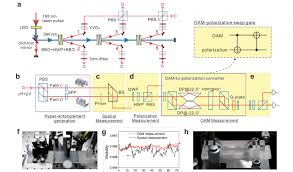
They used
* 30 single-photon interferometers in total.
* The outputs are detected by 48 single-photon detectors
Scheme and experimental setup for creating and verifying 18-qubit GHZ state consisting of six photons and three degrees of freedom. a. The generation of six-photon polarization-entangled GHZ state. An ultrafast laser with a central wavelength of 788 nm, a pulse duration of 120 fs and a repetition rate of 76 MHz is focused on a lithium triborate (LBO) and up-converted to 394 nm. The ultraviolet laser is focused on three custom-designed sandwich-like nonlinear crystals, each consists of two 2-mm thick β-barium borates (BBOs) and one half-wave plate (HWP), to produce three pairs of entangled photons. In each output, two pieces of YVO4 crystals with different thickness and orientation are used for spatial and temporal compensation for the birefringence effects. The three pairs of entangled photons are combined on two polarizing beam splitters (PBSs) to generate a six-photon polarization-entangled GHZ state. b.