










Breaking News
 This is the future we shall bring into being
 Elon Musk's Vision For The Future Looks Like A Movie
 Phosphorus Munitions Fired by Israel Burn Groves, Orchards in Southern Lebanon
 Iran's IRGC Warns It Will Expand 'Geography of the War' If the US Attacks Again
Top Tech News
 BEYOND THE MOON: NASA plans a nuclear-powered fleet to push DEEPER into space
 Big Oil Backs Mazama's $135 Million Bet On Superhot Geothermal
 Quantum compass takes flight on Northrop's Lumberjack drone
 Terrifying AI Behavior Even Its Creators Couldn't Explain
 WW3 Near-Miss? AI Hallucinated Nuclear Weapons Components Aboard Chinese Vessel Bound For Iran
 Stripe Is Building the Toll Road for the Machine Economy
 Toyota Dakar hopeful swaps twin-turbo V6 for hydrogen fuel cells
 4-min turbo-inflatable cubic camp castle is now available in the USA
 Researchers Used Claude To Hack OpenAI Employee Accounts
 Chinese Scientists Develop New Oil Refining Method That Cuts Energy Use by 90%



Better insulation with nanowood, Transparent wood and solar devices made from wood
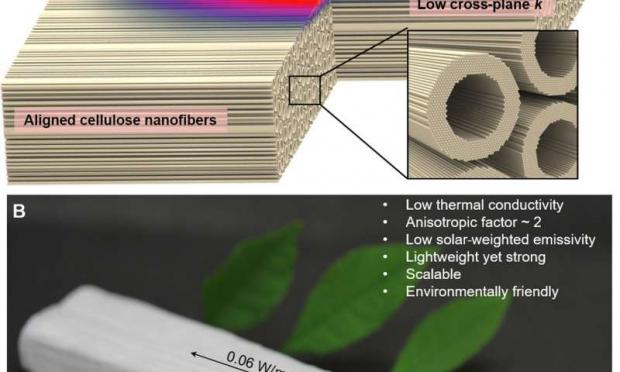
There has been a growing interest in thermal management materials due to the prevailing energy challenges and unfulfilled needs for thermal insulation applications. We demonstrate the exceptional thermal management capabilities of a large-scale, hierarchal alignment of cellulose nanofibrils directly fabricated from wood, hereafter referred to as nanowood. Nanowood exhibits anisotropic thermal properties with an extremely low thermal conductivity of 0.03 W/m·K in the transverse direction (perpendicular to the nanofibrils) and approximately two times higher thermal conductivity of 0.06 W/m·K in the axial direction due to the hierarchically aligned nanofibrils within the highly porous backbone. The anisotropy of the thermal conductivity enables efficient thermal dissipation along the axial direction, thereby preventing local overheating on the illuminated side while yielding improved thermal insulation along the backside that cannot be obtained with isotropic thermal insulators. The nanowood also shows a low emissivity of less than 5% over the solar spectrum with the ability to effectively reflect solar thermal energy.