










Breaking News
 "Begin Preparing Yourself..." - Jeffrey Sachs
 The 5-Year Treasury Just Broke 5%... The Whole Curve Is Next
 ICE Denounced for Enacting 'Official Government Policy of Disappearing People'
 Google Just Told Canadian Adults: Give Us Your ID and a Selfie Or Else…And It's Starting Now!!
Top Tech News
 Tesla Model 3 killer charges from 10 to 97% in just 9 minutes
 World-first unpowered DNA computer sets speed record
 I Power 5 Buildings Off-Grid. Here's How
 The US government is pushing hard to get a working nuclear fission reactor into space by late 2028
 SpaceX Starmind AI in Space Radiator
 China Will Dominate Global Nuclear Energy Through 2035, Analyst Says
 These Absolutely Wild-Looking EVs Are Saudi Arabia's First Homegrown Cars
 BEYOND THE MOON: NASA plans a nuclear-powered fleet to push DEEPER into space
 Big Oil Backs Mazama's $135 Million Bet On Superhot Geothermal
 Quantum compass takes flight on Northrop's Lumberjack drone


Why is Paul Allen building the world's largest airplane? Perhaps to launch a space ...
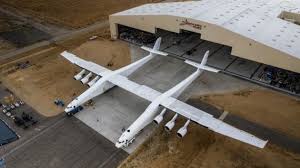
A massive airplane being built by Microsoft co-founder Paul Allen moved a step closer to flight last week, when it crept out of its hangar in Mojave, Calif., and practiced rolling down the runway, hitting a top speed of 46 mph.
Known as Stratolaunch, the plane has a wingspan even greater than that of business mogul Howard Hughes's famed Spruce Goose and is designed to carry as many as three rockets, tethered to its belly, to about 35,000 feet. Once aloft, the rockets would drop, then fire their engines and deliver satellites to orbit.
But Allen has even bigger ambitions for Stratolaunch and is considering pairing it with a new space shuttle that's known inside the company as Black Ice.
In exclusive interviews last summer, Allen and Jean Floyd, Stratolaunch System's chief executive, laid out the company's plans for the giant plane, providing an answer to why anyone would want to build an aircraft that has 28 wheels, six 747 jet engines and a wingspan longer than a football field.
"I would love to see us have a full reusable system and have weekly, if not more often, airport-style, repeatable operations going," Allen said in an interview in his Seattle office.
The Black Ice space plane — should it be built — would be about as big as the former space shuttle developed by NASA and capable of staying up for at least three days. It could be launched from virtually anywhere in the world, as long as the runway could accommodate Stratolaunch's size. And it would be capable of flying to the International Space Station, taking satellites and experiments to orbit, and maybe one day even people — though there are no plans for that in the near-term.
Then it would land back on the runway, ready to fly again.

Read More...