










Breaking News
 "Begin Preparing Yourself..." - Jeffrey Sachs
 The 5-Year Treasury Just Broke 5%... The Whole Curve Is Next
 ICE Denounced for Enacting 'Official Government Policy of Disappearing People'
 Google Just Told Canadian Adults: Give Us Your ID and a Selfie Or Else…And It's Starting Now!!
Top Tech News
 Tesla Model 3 killer charges from 10 to 97% in just 9 minutes
 World-first unpowered DNA computer sets speed record
 I Power 5 Buildings Off-Grid. Here's How
 The US government is pushing hard to get a working nuclear fission reactor into space by late 2028
 SpaceX Starmind AI in Space Radiator
 China Will Dominate Global Nuclear Energy Through 2035, Analyst Says
 These Absolutely Wild-Looking EVs Are Saudi Arabia's First Homegrown Cars
 BEYOND THE MOON: NASA plans a nuclear-powered fleet to push DEEPER into space
 Big Oil Backs Mazama's $135 Million Bet On Superhot Geothermal
 Quantum compass takes flight on Northrop's Lumberjack drone


DARPA aims for 100-fold performance improvement for defense-related sensors and devices
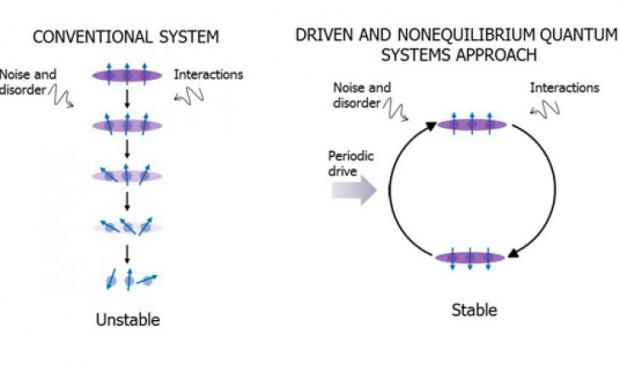
If you wait long enough, interactions with the environment will make the state behave like a conventional classical system. In many cases, this time is significantly short. DARPA, with an eye on practical quantum devices and sensors in compact sizes, has set its sight on demonstrating protocols that can dramatically extend the longevity of the coherence of quantum systems.
DARPA's Defense Sciences Office (DSO) today announced a new fundamental research program, Driven and Nonequilibrium Quantum Systems (DRINQS) to investigate a recent paradigm shift in quantum research, which maintains that periodically driving a system out of equilibrium may stabilize its coherence.
"A simple illustration of the concept of driving something out of equilibrium to increase its stability is the well-known trick of making an inverted broom stand up on the palm of your hand or on one of your fingertips," said Ale Lukaszew, DARPA program manager. "If you hold your hand still, the broom is unstable and will fall over quickly. But if you drive the broom out of equilibrium by moving your hand around periodically, you can make the broom very stable, so it remains upright indefinitely."