










Breaking News
 Iran Is Watching Its Economy Collapse in Real Time
 California's New Tire Rule will Result in Higher Costs and More Highway Deaths
 Covid Was a Praxeological Test. Too Many Libertarians Failed.
 This Is What A "Perfect Storm" Looks Like:
Top Tech News
 Tesla Model 3 killer charges from 10 to 97% in just 9 minutes
 World-first unpowered DNA computer sets speed record
 I Power 5 Buildings Off-Grid. Here's How
 The US government is pushing hard to get a working nuclear fission reactor into space by late 2028
 SpaceX Starmind AI in Space Radiator
 China Will Dominate Global Nuclear Energy Through 2035, Analyst Says
 These Absolutely Wild-Looking EVs Are Saudi Arabia's First Homegrown Cars
 BEYOND THE MOON: NASA plans a nuclear-powered fleet to push DEEPER into space
 Big Oil Backs Mazama's $135 Million Bet On Superhot Geothermal
 Quantum compass takes flight on Northrop's Lumberjack drone


First Topological superconductor will enable new very long coherence time Quantum computers
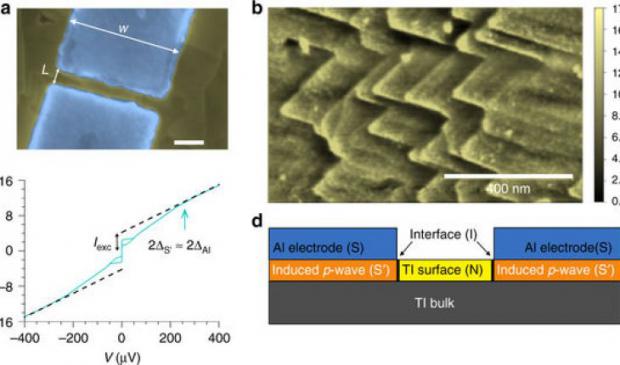
In solid state materials Majorana fermions only appear to occur in what are known as topological superconductors – a new type of superconductor that is so new and special that it is hardly ever found in practice.
Quantum computers with topological superconductors should have very long coherence times.
"Our experimental results are consistent with topological superconductivity," says Floriana Lombardi, Professor at the Quantum Device Physics Laboratory at Chalmers.
To create their unconventional superconductor they started with what is called a topological insulator made of bismuth telluride, Be2Te3. A topological insulator is mainly just an insulator – in other words, it does not conduct current – but it conducts current in a very special way on the surface. The researchers have placed a layer of a conventional superconductor on top, in this case aluminium, which conducts current entirely without resistance at really low temperatures.