










Breaking News
 This is the future we shall bring into being
 Elon Musk's Vision For The Future Looks Like A Movie
 Phosphorus Munitions Fired by Israel Burn Groves, Orchards in Southern Lebanon
 Iran's IRGC Warns It Will Expand 'Geography of the War' If the US Attacks Again
Top Tech News
 BEYOND THE MOON: NASA plans a nuclear-powered fleet to push DEEPER into space
 Big Oil Backs Mazama's $135 Million Bet On Superhot Geothermal
 Quantum compass takes flight on Northrop's Lumberjack drone
 Terrifying AI Behavior Even Its Creators Couldn't Explain
 WW3 Near-Miss? AI Hallucinated Nuclear Weapons Components Aboard Chinese Vessel Bound For Iran
 Stripe Is Building the Toll Road for the Machine Economy
 Toyota Dakar hopeful swaps twin-turbo V6 for hydrogen fuel cells
 4-min turbo-inflatable cubic camp castle is now available in the USA
 Researchers Used Claude To Hack OpenAI Employee Accounts
 Chinese Scientists Develop New Oil Refining Method That Cuts Energy Use by 90%



Stronger and tougher fiber created by MIT
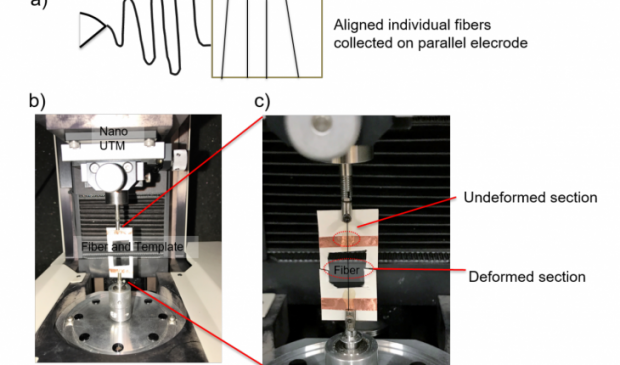
Journal of Material Science – Ultrafine high performance polyethylene fibers
Abstract
Stiff, strong and tough ultrafine polyethylene fibers that rival the best high-performance fibers, but with diameters less than one micron, are fabricated for the first time by "gel-electrospinning." In this process, solution concentration and process temperatures are chosen to induce the formation of gel filaments "in flight," which are subsequently drawn at high rates as a consequence of the whipping instability. The resulting submicron-diameter fibers exhibited Young's moduli of 73 ± 13 GPa, yield strengths of 3.5 ± 0.6 GPa, and toughnesses of 1.8 ± 0.3 GPa, on average. Among the smallest fibers examined, one with a diameter of 490 ± 50 nm showed a Young's modulus of 110 ± 16 GPa, ultimate tensile strength of 6.3 ± 0.9 GPa, and toughness of 2.1 ± 0.3 GPa, a combination of mechanical properties that is unparalleled among polymer fibers to date. The correlation of stiffness, strength and toughness with fiber diameter is attributed to high crystallinity and crystallite orientation, combined with fewer defects and enhanced chain slip associated with small diameter and high specific surface area. Gel-electrospinning improves the prospects for production of such fibers at scale.