










Breaking News
 The Download: GLOBAL WAR LOOMING, GOVERNMENT AT YOUR DOOR & DOCTORS...
 Episode 495: AI'S FREE PASS, NIH FINALLY WAKES UP & CHILDHOOD DEATH BOMBSHELL
 Xi backs AI safety with Trump, draws Taiwan line, urges Iran talks
 The Israeli Lobby Boasts of Its Rule of America
Top Tech News
 Tesla Model 3 killer charges from 10 to 97% in just 9 minutes
 World-first unpowered DNA computer sets speed record
 I Power 5 Buildings Off-Grid. Here's How
 The US government is pushing hard to get a working nuclear fission reactor into space by late 2028
 SpaceX Starmind AI in Space Radiator
 China Will Dominate Global Nuclear Energy Through 2035, Analyst Says
 These Absolutely Wild-Looking EVs Are Saudi Arabia's First Homegrown Cars
 BEYOND THE MOON: NASA plans a nuclear-powered fleet to push DEEPER into space
 Big Oil Backs Mazama's $135 Million Bet On Superhot Geothermal
 Quantum compass takes flight on Northrop's Lumberjack drone


Prototype for two beam laser fusion system within a decade if no major hurdles arise
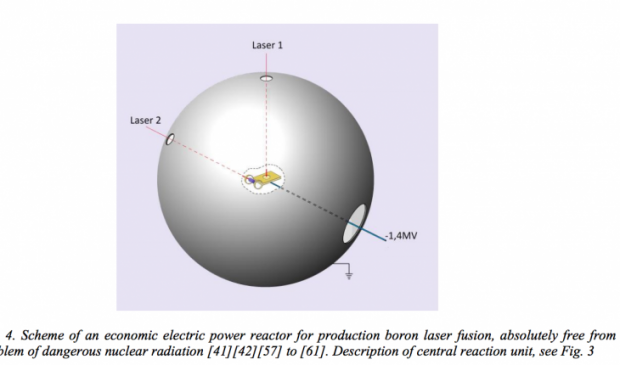
Dramatic advances in laser technology are close to making the two-laser approach feasible, and a spate of recent experiments around the world indicate that an 'avalanche' fusion reaction could be triggered in the trillionth-of-a-second blast from a petawatt-scale laser pulse, whose fleeting bursts pack a quadrillion watts of power. If scientists could exploit this avalanche, Hora said, a breakthrough in proton-boron fusion was imminent.
"It is a most exciting thing to see these reactions confirmed in recent experiments and simulations," said Hora, an Emeritus Professor of Theoretical Physics at UNSW. "Not just because it proves some of my earlier theoretical work, but they have also measured the laser-initiated chain reaction to create one billion-fold higher energy output than predicted under thermal equilibrium conditions."
An Australian spin-off company, HB11 Energy, holds the patents for Hora's process. "If the next few years of research don't uncover any major engineering hurdles, we could have a prototype reactor within a decade," said Warren McKenzie, managing director of HB11.