










Breaking News
 The Download: GLOBAL WAR LOOMING, GOVERNMENT AT YOUR DOOR & DOCTORS...
 Episode 495: AI'S FREE PASS, NIH FINALLY WAKES UP & CHILDHOOD DEATH BOMBSHELL
 Xi backs AI safety with Trump, draws Taiwan line, urges Iran talks
 The Israeli Lobby Boasts of Its Rule of America
Top Tech News
 Tesla Model 3 killer charges from 10 to 97% in just 9 minutes
 World-first unpowered DNA computer sets speed record
 I Power 5 Buildings Off-Grid. Here's How
 The US government is pushing hard to get a working nuclear fission reactor into space by late 2028
 SpaceX Starmind AI in Space Radiator
 China Will Dominate Global Nuclear Energy Through 2035, Analyst Says
 These Absolutely Wild-Looking EVs Are Saudi Arabia's First Homegrown Cars
 BEYOND THE MOON: NASA plans a nuclear-powered fleet to push DEEPER into space
 Big Oil Backs Mazama's $135 Million Bet On Superhot Geothermal
 Quantum compass takes flight on Northrop's Lumberjack drone


Key component for quantum computers miniaturized by 1000 times
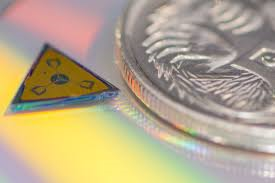
Making parts like these smaller will help enable quantum computers with millions of qubits.
Above – Lead author of the study, PhD candidate Alice Mahoney, in the quantum science laboratories at the Sydney Nanoscience Hub.
The Sydney team's component, coined a microwave circulator, acts like a traffic roundabout, ensuring that electrical signals only propagate in one direction, clockwise or anti-clockwise, as required. Similar devices are found in mobile phone base-stations and radar systems, and will be required in large quantities in the construction of quantum computers. A major limitation, until now, is that typical circulators are bulky objects the size of your hand.
They used the properties of topological insulators to slow the speed of light in the material. This miniaturization paves the way for many circulators to be integrated on a chip and manufactured in the large quantities that will be needed to build quantum computers.